
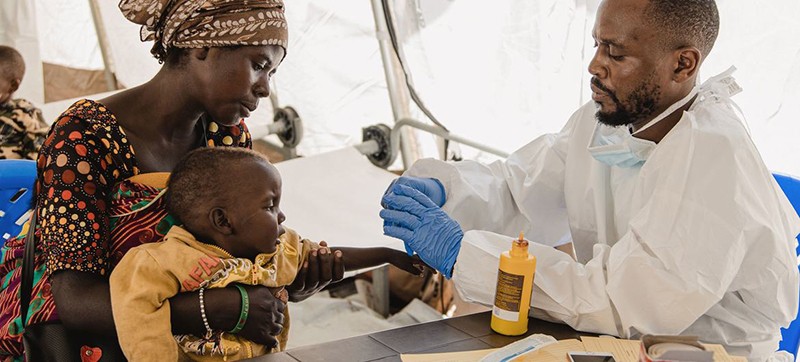
The escalating crisis is also widening critical gaps in healthcare and protection, amid a broader surge in infectious diseases.
And with nearly seven million people forcibly displaced by violence since advances by M23 rebels earlier this year, the DRC is facing one of the world’s most complex displacement crises, according to the UN migration agency (IOM).
Living in overcrowded and under-resourced camps, displaced populations are increasingly vulnerable to both disease and attack.
Since January 2025 alone, over 660,000 people have been forced to flee the Goma region after Government forces lost control of the key city along with Bukavu to the south.
Tipping Point
The scale of the humanitarian needs in the country has reached a tipping point, according to IOM, with outbreaks of mpox and anthrax underway in the east.
While both mpox and anthrax typically affect livestock and other animals, food insecurity resulting from the ongoing conflict, paired with unsanitary living conditions in displacement camps, puts humans at greater risk of transmission.
Dangerous Infections
Both the potentially deadly infections can be contracted through contact with infected or contaminated animals. Although anthrax is not generally contagious, mpox is, the World Health Organization (WHO) underlines.
Mpox is typically accompanied by fever and rash and rarely requires hospitalisation, while all human cases of anthrax do, the UN health agency added.
Since 22 March, following the deaths of dozens of buffalo and hippopotamuses in Virunga National Park from anthrax poisoning, 16 suspected human cases of anthrax have been reported, including one confirmed case. One person has died so far.
Outbreak Response
WHO is conducting assessments in the eastern part of the DRC to determine the risk of the anthrax infection spreading further across the region.
As both mpox and anthrax are treatable with antibiotics, and preventable through vaccination, WHO and its partners are working to prevent future outbreaks by adopting a unified approach, prioritising human, animal and environmental safety.
Awareness campaigns and efforts to vaccinate livestock against anthrax are now underway.