
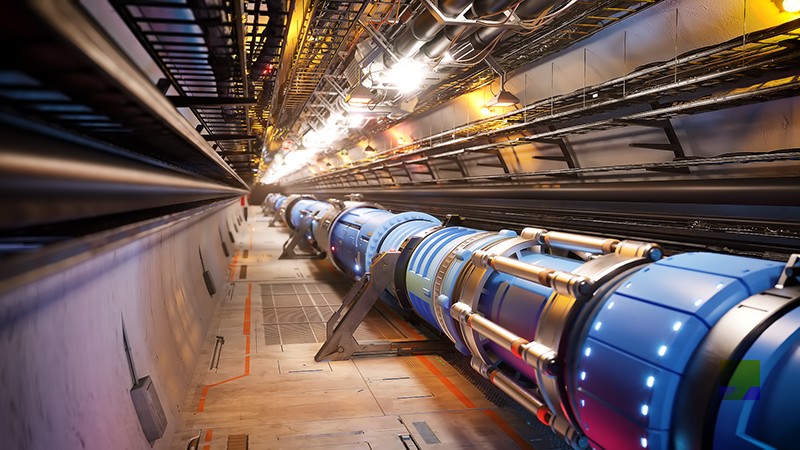
Particle colliders are unique instruments that allow the smallest constituents of matter and the laws of the universe to be studied at the most fundamental level.
In line with the recommendations of the 2020 update of the European Strategy for Particle Physics (ESPP), CERN has conducted a study to assess the feasibility of a possible Future Circular Collider (FCC).
The study has been undertaken in collaboration with many institutions in CERN’s Member and Associate Member States and beyond and its report was issued on 31 March 2025.
Following review by the CERN Council’s subordinate bodies, the Scientific Policy Committee and the Finance Committee, and by independent expert committees, the Council delegates examined the FCC Feasibility Study report at a dedicated meeting held at CERN on Nov 6-7.
The independent expert committees stated that, based on the documentation presented, the FCC appears technically feasible, no showstoppers having been identified so far.
In its conclusions, the CERN Council restated its commitment to maintaining CERN as a world leader laboratory in science and technology.
It considers that the FCC would provide the platform for a visionary physics programme addressing many of the open questions in particle physics, notably on the Higgs boson, that are critical to understanding the foundations of the Standard Model and to opening up opportunities for discovering new physics beyond the Standard Model, while at the same time driving the development of new technologies that will have a significant positive impact on society.
"The CERN Council reaffirmed its strong wish to maintain CERN as a leader in particle physics and views the continuation of the FCC study as a step towards this goal," said Costas Fountas, President of the CERN Council.
It welcomed the CERN Management’s work over the past several years to develop a funding model and financial scenarios based on varying levels of resources that might be available both inside and outside the CERN Budget.
The Council concluded that the Feasibility Study provides the basis for the FCC studies to continue and that the funding scenarios presented and the financial pledges obtained so far provide the basis for the continuation of the work towards securing the full financial commitments required for approval of the FCC project.
"The breadth and depth of the FCC Feasibility Study are remarkable and were made possible only through the collective effort of around 1,500 people from 162 institutes in 38 countries", said Fabiola Gianotti, Director-General of CERN.
"The CERN Council conclusions mark a very important milestone for the FCC on the road toward its possible approval."
As part of the ongoing update of the ESPP, a community-driven process, recommendations on CERN’s future flagship project will be developed in December 2025 at a dedicated meeting in Ascona, Switzerland.