
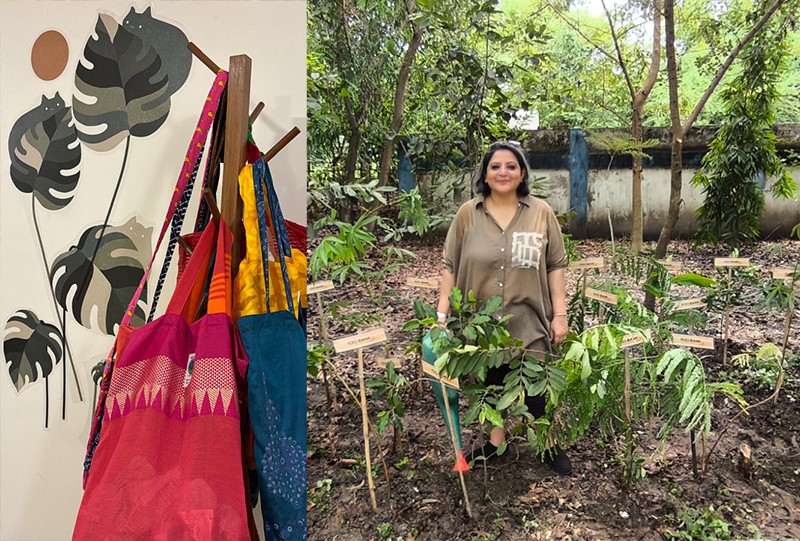
Q: Who is Somini Sen Dua and what motivated you to turn into a climate activist?
A: I have over two decades of corporate experience as a lifestyle publicist. But the pandemic was a turning point. Covid took away my pet, family, and eventually my father. To cope, I began gardening—and that journey evolved into climate change activism. It helped me heal, and I realised I could give back to the Earth.
In 2020, I decided to start learning pottery. In the corporate rat race, I had forgotten to nurture my artistic skills and hobbies. News and media kept us abreast of the horrendous reality-- people gasping for oxygen-- and I felt a deep urge to do something, to be the change.
Moulding clay is not easy, but after several attempts, I eventually succeeded in giving it shape. Around the same time, I had been reading extensively about climate change. This led to the name Mrittika --- a reminder that we all return to the earth, whether as ash or in coffins. I realised that people connect with stories. So, Mrittika Earthy Talks Foundation was registered to reach out to the community, as we all share this planet and must take responsibility for it.
Q: Tell us about the MET Foundation and its key focus areas.
A: At Mrittika Earthy Talks Foundation, we focus on two urgent issues—urban afforestation and plastic & fabric waste management. Our flagship project, Arannya, is a Miyawaki forest in Kolkata with over 1,150 trees. The other focus is fighting plastic pollution by encouraging people to adopt eco-friendly lifestyle choices and creating sustainable fashion from discarded fabric.
Q: Why do you call plastic a curse?
A: Plastic was once considered a miracle material, but now it’s a menace. It has entered our soil, water, air, and even our bodies as microplastics. Each of us may unknowingly consume the equivalent of a credit card’s worth of plastic every week. This is why MET works to replace plastic with eco-friendly alternatives, like cloth bags, upcycled fabric products, and ecobricks.
Q: What are ecobricks and how are you promoting them?
A: Ecobricks are made by stuffing single-use plastic (SUP) into PET bottles until they become solid building blocks. At MET, we teach schoolchildren how to make them. In 2022, we even built a Christmas tree entirely from ecobricks—an example of waste-to-wealth innovation.
Q: Do you see a shift in consumer mindsets?
A: Yes, especially among the youth. More people are rejecting fast fashion and embracing sustainable fashion in India—through thrifting, upcycling, and eco-friendly consumption. The focus is slowly shifting from material excess to health and happiness, which is very encouraging.
Q: What are the major challenges in fighting plastic pollution in Kolkata?
A: The biggest hurdles are lack of waste segregation at source, weak enforcement of plastic bans, and low awareness even among the educated. If single-use plastic is banned, why is production still happening? Where are the affordable, eco-friendly alternatives? Without systemic change, the burden falls only on consumers.
Q: What are the future campaigns you are planning to expand greenery in the city? How do you use social media in your activism?
A: As a part of our afforestation endeavours, we have successfully created an urban forest based on the Miyawaki concept. It took over a year of persistent effort and dedicated outreach to make this reality. Arannya--our urban forest--now houses 1150 trees. Trees are not only a source of oxygen, imperative to life, but their canopy also absorbs carbon dioxide (CO2) through a process known as carbon sequestration. This process is vital for purifying the air we breathe, considering the fact that in urban spaces, the quality of air is extremely poor.
On World Earth Day-- April 22nd, we have, for the past three years, been running a campaign named #SOTO: Switch Off, Tap Off. Currently held virtually, this initiative is supported by institutions, eateries and individuals, and involves a 10-minute collective abstinence or outage of electricity and water usage. The message is simple yet urgent: we share only one Earth. If we fail to preserve our natural resources and worship the planet, we ultimately diminish the value of life itself.
Gandhi remains my guiding light in this journey.
Q: Do you think schools and educational institutions are working enough to create environmental awareness in society?
A: Though EVS or Environmental Science is taught as a subject across all education boards in India, children need more than just theoretical knowledge-- they need practical experience. They have forgotten how to admire nature, to smell the rain, to respect farmers, or to lose themselves while gazing at the sky. They should also be made aware of the importance of waste management and biodiversity.
Q: What is your ultimate message?
A: There is only one Earth. We must fight plastic pollution in Kolkata and across India, expand urban afforestation, and embrace eco-friendly living. This is not charity—it’s survival. Our collective duty is to protect nature for ourselves and for the generations to come.