
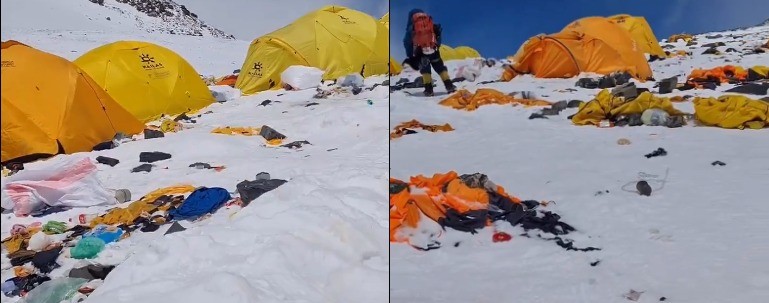
The plan was unveiled amid mounting criticism that Mount Everest has effectively been turned into a dumping ground due to unchecked human activity.
In recent years, a portion of public funds has been allocated to Everest clean-up campaigns led by the Nepali Army. While these operations have succeeded in removing large volumes of waste from the mountain, officials familiar with the process say the initiatives have courted controversy over financial transparency and accountability, reported The Kathmandu Post.
Experts told the newspaper that the sheer volume of waste recovered during each climbing season underscores the urgent need for more sustainable mountaineering practices.
Tons of waste left behind by climbers and Sherpas — including discarded oxygen canisters, plastic bottles, ropes, food waste and human excreta — have severely polluted Everest’s high-altitude environment.
Each year, the base camp transforms into a dense tent city housing hundreds of climbers and support staff during the peak climbing season, significantly adding to the environmental strain.
“The government has decided to study whether relocating the base camp is feasible for the long-term sustainability of the mountain,” Himal Gautam, Director at Nepal’s Department of Tourism, told The Kathmandu Post.
Disheartening to see the accumulation of garbage at Camp IV on Mt #Everest (8848.86 m), where human life mostly depends on supplementary oxygen, the mountain itself is being left to suffocate beneath our waste.
— Everest Today (@EverestToday) December 19, 2025
The garbage accumulating at the highest camps reflects a deeper… pic.twitter.com/NXNe08TlXc
“The base camp is overcrowded and fragile. The study will offer perspectives on identifying an alternative site,” he said.
Gautam also noted that the court has directed the government to limit climbing permits based on the mountain’s carrying capacity and the availability of support services.
“Permits should be issued only after clearly specifying the allowable number of climbers,” he added.