
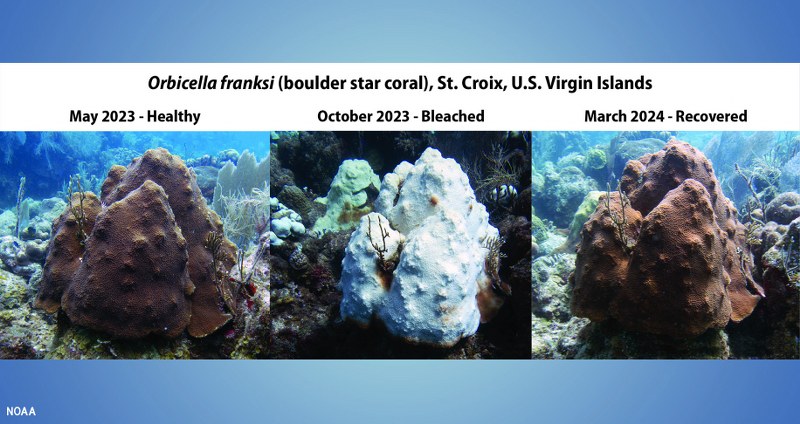
Bleaching-level heat stress, as remotely monitored and predicted by NOAA’s Coral Reef Watch (CRW), has been — and continues to be — extensive across the Atlantic, Pacific and Indian Ocean basins. CRW's heat-stress monitoring is based on sea surface temperature data, spanning 1985 to the present, from a blend of NOAA and partner satellites.
"From February 2023 to April 2024, significant coral bleaching has been documented in both the Northern and Southern Hemispheres of each major ocean basin," said Derek Manzello, Ph.D., NOAA CRW coordinator.
Since early 2023, mass bleaching of coral reefs has been confirmed throughout the tropics, including in Florida in the U.S.; the Caribbean; Brazil; the eastern Tropical Pacific (including Mexico, El Salvador, Costa Rica, Panama and Colombia); Australia’s Great Barrier Reef; large areas of the South Pacific (including Fiji, Vanuatu, Tuvalu, Kiribati, the Samoas and French Polynesia); the Red Sea (including the Gulf of Aqaba); the Persian Gulf; and the Gulf of Aden.
NOAA has received confirmation of widespread bleaching across other parts of the Indian Ocean basin as well, including in Tanzania, Kenya, Mauritius, the Seychelles, Tromelin, Mayotte and off the western coast of Indonesia.
“As the world’s oceans continue to warm, coral bleaching is becoming more frequent and severe,” Manzello said. “When these events are sufficiently severe or prolonged, they can cause coral mortality, which hurts the people who depend on the coral reefs for their livelihoods.”
Coral bleaching, especially on a widespread scale, impacts economies, livelihoods, food security and more, but it does not necessarily mean corals will die. If the stress driving the bleaching diminishes, corals can recover and reefs can continue to provide the ecosystem services we all rely on.
“Climate model predictions for coral reefs have been suggesting for years that bleaching impacts would increase in frequency and magnitude as the ocean warms,” said Jennifer Koss, director of NOAA’s Coral Reef Conservation Program (CRCP).
Because of this, the NOAA CRCP incorporated resilience-based management practices and increased the emphasis on coral restoration in its 2018 strategic plan, and funded a National Academies of Sciences’ study, which led to the publication of the 2019 Interventions to Increase the Resilience of Coral Reefs.offsite link
Koss said, “We are on the frontlines of coral reef research, management and restoration, and are actively and aggressively implementing the recommendations of the 2019 Interventions Report.”
The 2023 heatwave in Florida was unprecedented. It started earlier, lasted longer and was more severe than any previous event in that region. During the bleaching event, NOAA learned a great deal while engaging in interventions to mitigate harm to corals. Through its Mission: Iconic Reefs programoffsite link, NOAA made significant strides to offset some of the negative impacts of global climate change and local stressors on Florida’s corals, including moving coral nurseries to deeper, cooler waters and deploying sunshades to protect corals in other areas.
This global event requires global action. The International Coral Reef Initiativeoffsite link (ICRI), which NOAA co-chairs, and its international members are broadly sharing and already applying resilience-based management actions and lessons learned from the 2023 marine heatwaves in Florida and the Caribbean. ICRI and its members are helping to advance coral interventions and restoration in the face of climate change by funding scientific research on best management practices and implementing its Plan of Action