
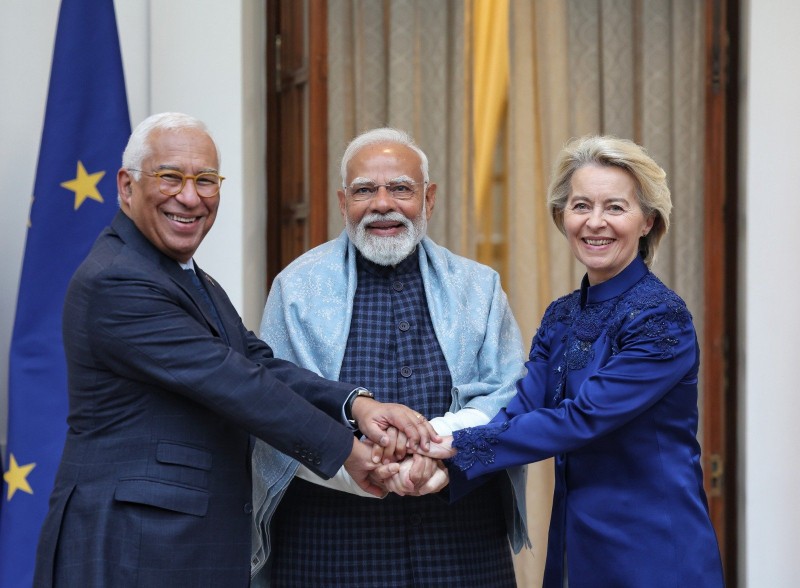
The landmark accord, after nearly two decades of intermittent talks, is poised to redefine people-to-people movement and strategic cooperation between New Delhi and 27 EU member states.
Easier mobility for Indian talent
Central to the pact is a mobility agreement that promises easier access for Indian students, professionals, and workers across the European Union.
Under the framework, the EU has committed to “uncapped mobility for Indian students,” enabling smoother access to study and work opportunities across member states.
European Commission President Ursula von der Leyen noted that this mobility push will facilitate collaboration on frontier research, including Horizon Europe, the bloc’s flagship science and innovation programme—offering Indian researchers and startups greater exposure to cutting-edge health, clean energy and frontier technologies.
We are launching the first EU legal gateway office in India. It will be a one-stop hub to support Indian talent moving to Europe: EU President @vonderleyen#IndiaEUTradeDeal pic.twitter.com/ANuoJdCC3K
— Piyush Goyal (@PiyushGoyal) January 27, 2026
Beyond students, the pact sets up structured commitments for business mobility, intra-corporate transferees and independent professionals in key sectors such as IT, professional services, R&D, and education.
It also establishes frameworks for social security coordination and post-study work pathways, unlocking significant career opportunities in Europe for Indian professionals.
Analysts describe this as a qualitative shift in India–EU human capital integration—moving from episodic academic exchanges to sustained professional flows that strengthen skills ecosystems on both sides.
Strategic defence and security cooperation
Alongside trade and mobility, India and the EU signed a Security and Defence Partnership, marking the first overarching defence framework between them.
This agreement widens the scope of cooperation across maritime security, cyber defence, counterterrorism, space and emerging technologies.
Defence Minister Rajnath Singh termed the pact a “significant step” toward deeper India-EU engagement amid a complex global security landscape.
European security officials, including EU security chief Kaja Kallas, have highlighted further cooperation in defence industrial collaboration and strategic dialogues.
Experts see three core pillars emerging from this partnership:
Joint defence industrial collaboration: European defence majors can now explore partnerships with Indian private sector firms without historic bureaucratic restrictions.
This opens possibilities for co-development and manufacture of defence platforms under India’s “Make in India” initiative, leveraging European technology and Indian production scale.
Cybersecurity and emerging threats: With cyber resilience now central to national defence, the pact establishes collaborative frameworks to counter hybrid threats, boosting India’s access to advanced EU cyber capabilities while aligning European firms with India’s dynamic digital market.
Maritime security in the Indo-Pacific: The EU’s involvement adds a new strategic dimension to Indo-Pacific security architecture.
As the region navigates shifting alliances and rules-based order, Indian and European navies are positioned to deepen operational cooperation.
Taken together, defence analysts note that the pact institutionalises strategic trust between two democratic powers, extending beyond transactional trade to enduring security cooperation.
Economic levers shaping strategic outcomes
While the trade agreement primarily focuses on tariff liberalisation—eliminating or reducing duties on over 96% of traded goods and significantly reducing tariffs on European imports such as automobiles—it also underpins the strategic elements of the broader partnership.
For example, reduced trade barriers are expected to bolster industrial linkages that support joint R&D, cross-border supply chains and defence technology collaboration.
Indian exporters gain improved access to the EU services market, and European investment in Indian high-technology and defence sectors is set to increase.
Strategic significance in a multipolar world
Beyond specific sectors, the combined effect of mobility, trade and security cooperation sends a clear geopolitical signal: India is emerging as a pivotal node in a multipolar global order, balancing relationships with Western powers while deepening ties with one of the world’s largest economic blocs.
Both Prime Minister Narendra Modi and von der Leyen emphasised that the deal is not just commercial but a strategic partnership built on shared democratic values, economic opportunity, and collective security.