
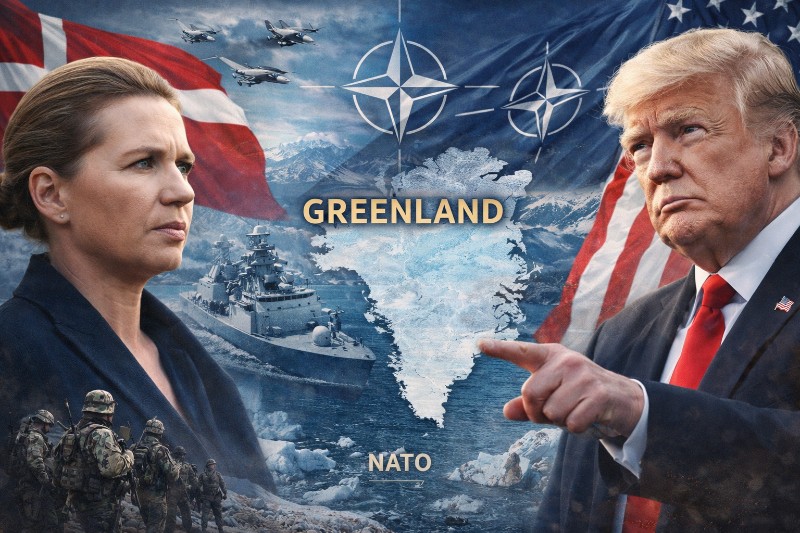
President Donald Trump has repeatedly expressed his determination to assume full control of Greenland, a Danish territory and a strategically vital Arctic island.
Both the US and Denmark are NATO members, placing the alliance in an unprecedented position where one member is openly threatening another.
For Copenhagen, the situation has sparked uncomfortable historical echoes.
During the 1974 Cyprus crisis between Greece and Turkey — both NATO members — Denmark had reportedly argued that the alliance was not obligated to protect a member state from another member.
That stance has now returned to haunt it.
Former Greek finance minister Yanis Varoufakis underscored this irony in a post on X, stating that NATO defends members from external enemies, not internal aggression.
Does Mr Trump have a right to help himself to Greenland? Of course he does not. Yes, he is right to say that Denmark’s only claim to Greenland is that some of its ships disembarked centuries ago there and took that land. But, how exactly did the Europeans take North America,…
— Yanis Varoufakis (@yanisvaroufakis) January 19, 2026
He noted that Denmark once backed this interpretation and is now confronting the consequences of that logic.
NATO’s legal 'grey zone'
Established in 1949 to counter external threats, particularly from the Soviet Union, NATO’s founding principle is collective defence.
Article 5 famously declares that an attack on one member is an attack on all.
However, the charter remains silent on what happens when aggression comes from within the alliance.
Trump’s rhetoric about Greenland has intensified fears among European leaders.
Several experts warn that any US attempt to seize the island by force could deal a fatal blow to NATO’s credibility.
While European nations have publicly backed Denmark, their response has been largely symbolic.
The UK and Norway reportedly sent only one and two soldiers, respectively, as part of a reconnaissance mission.
Trump reacted angrily, imposing a 10 percent tariff on European countries supporting Denmark, escalating tensions further.
Cyprus 1974: A troubling precedent
The current standoff evokes memories of the Cyprus crisis nearly five decades ago.
Greece and Turkey, both NATO members since 1952, clashed over Cyprus after a Greek-backed coup sought to annex the island.
Turkey invaded in July 1974, citing threats to Turkish Cypriots, and later launched a second offensive in August, occupying around 36 percent of the territory.
The conflict resulted in thousands of deaths and permanently divided the island.
Greece appealed to NATO to intervene against Turkey, but the alliance remained passive.
The US attempted diplomatic mediation but did not apply military pressure on Ankara.
Disillusioned, Greece withdrew from NATO’s military command from 1974 to 1980, arguing the alliance had failed to protect it from a fellow member.
NATO’s structural weakness exposed
The Cyprus episode laid bare NATO’s core vulnerability: it was built to deter external enemies, not internal conflicts.
With no legal mechanism to address intra-alliance aggression, NATO stayed out, leaving Greece and Turkey to resolve their dispute alone.
Now, Denmark appears to be walking into the same institutional void. If the US moves aggressively on Greenland, NATO may find itself unable — or unwilling — to act decisively.
Unlike Greece in 1974, Denmark lacks significant military leverage.
While Washington spends over a trillion dollars annually on defence, Denmark’s military budget stood at roughly $10 billion in 2025, making the power imbalance stark.
Europe reacts, NATO stays silent
European leaders have openly expressed alarm.
Spanish Prime Minister Pedro Sanchez warned that a US invasion of Greenland would be the “death knell” of NATO, according to EuroNews.
The European Union has firmly backed Denmark, but NATO Secretary-General Mark Rutte has remained conspicuously silent.
Although Trump claimed on Truth Social that he has been in contact with Rutte, NATO has offered no formal stance.
While Article 4 allows consultations when a member feels threatened, Article 5 only applies to attacks from outside the alliance.
Greenland’s voice and NATO’s future
Greenland’s population, largely of Inuit heritage, has long demanded greater autonomy.
While it enjoys limited self-rule, Denmark controls defence and foreign policy. Any forced takeover by the US would not only violate Danish sovereignty but also disregard Greenlanders’ right to self-determination.
NATO survived the 1974 crisis, but the Greece-Turkey rift still lingers. Back then, the alliance eventually refocused on external threats.
Today, however, Trump’s aggressive posturing risks fracturing NATO from within.