
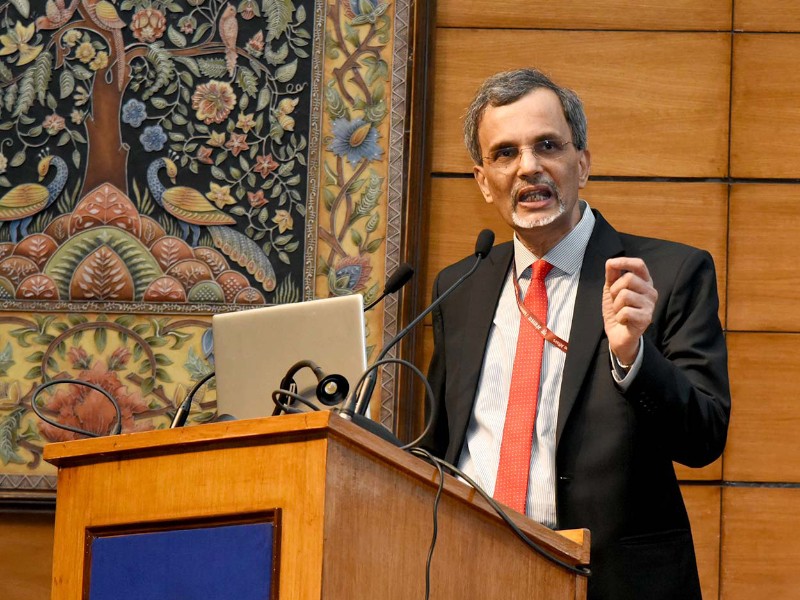
In an op-ed published in The Indian Express, Nageswaran and co-author Akash Poojari argued that India's ethanol policy could accommodate different requirements for older and newer vehicles.
Their proposal would allow owners of older vehicles to purchase E10 petrol, while newer vehicles continue to use E20.
E20 petrol contains 20 percent ethanol, compared with the 10 percent ethanol blend for which many older vehicles were designed.
Millions of older two-wheelers could be affected
Nageswaran pointed to the large number of vehicles still operating with engines designed for lower ethanol blends.
According to him, India has around 75-80 million two-wheelers built for E10.
The CEA said the concerns surrounding older vehicles extend beyond fuel efficiency.
Higher ethanol blends can create compatibility issues in some older fuel systems, particularly where components such as rubber seals were not designed to withstand greater ethanol exposure.
Carburettor-based vehicles can also face difficulties with higher ethanol blends, according to the argument presented by Nageswaran and Poojari.
Nageswaran wrote: “Restoring a lower blend at the pump, say, E10, alongside the option to buy E20, would calm public concern, lower total ethanol use instead of raising it, and protect the existing fleet while the retrofit programme catches up.”
The proposal would effectively create an alternative for older vehicles while allowing India's wider E20 transition to continue.
CEA challenges claims over E20 fuel efficiency
Nageswaran also sought to counter some of the claims being made about the impact of E20 on fuel efficiency.
“Ethanol is only a fifth of the blend, so the energy penalty is around 6 to 7 percent, not the 30 percent doing the rounds,” he wrote.
At the same time, he acknowledged that older vehicles could face specific technical problems because of the age and composition of their components.
“Older rubber seals that are not rated for ethanol are a separate problem, as they degrade on contact with the fuel, regardless of engine temperature,” Nageswaran wrote.
His argument therefore distinguishes between concerns about fuel consumption and the compatibility of older vehicle components with higher ethanol blends.
Debate shifts from E20 target to transition
India's ethanol-blending programme is designed to reduce dependence on imported crude oil while expanding the domestic market for ethanol produced from sugarcane, maize and other feedstocks.
The debate surrounding E20 has increasingly focused on how the transition should be managed for vehicles that were developed for lower ethanol blends.
For owners of older cars and two-wheelers, concerns include potentially lower fuel efficiency and the long-term effect of higher ethanol concentrations on vehicle components.
Nageswaran argued that these issues need to be considered as millions of older vehicles remain on Indian roads.
Replacing those vehicles will take time, while retrofitting the existing fleet would also require a gradual process.
His proposal does not seek to abandon E20. Instead, it calls for E10 to remain available as an option for vehicles that were originally designed to run on the lower blend.
Food, fuel concerns also raised
The CEA and Poojari also raised the broader implications of expanding ethanol production, including the debate over food and fuel.
Growing demand for ethanol feedstocks can affect the use of land and water, while also having implications for food availability.
The issue adds another dimension to India's long-term ethanol policy as the country expands blending in petrol.
Newer vehicles are increasingly designed to accommodate higher ethanol blends, but the existing fleet includes a large number of older models.
Kejriwal reacts to CEA's E10 proposal
The proposal also drew a political response from former Delhi Chief Minister Arvind Kejriwal, who shared the article on X.
“Chief Economic advisor of Modi government advocates E10 for older vehicles. Will Modi ji listen? Or will he replace the Chief Economic Advisor as he always does to dissenting voices?” Kejriwal wrote.
His remarks came as the discussion over E20 continued around vehicle compatibility, fuel efficiency and the broader objectives of India's ethanol-blending programme.
Ethanol industry opposes rollback
The proposal to restore E10 availability for older vehicles has also faced opposition from representatives of the ethanol industry.
Kushal Mittal, vice-president of the All India Distillers' Association (AIDA), argued that India should not reverse its ethanol policy based on public sentiment or perception.
“As a confident and forward-looking nation, we should not consider rolling back a carefully evaluated policy merely on the basis of sentiment or perception,” Mittal said.
“Scientific evidence, extensive testing and objective data must guide our energy policy,” he added.
Mittal said the transition to E20 had followed years of trials and assessments.
According to him, the government began pilot trials in 2016, followed by comprehensive evaluations in 2022 in consultation with automobile manufacturers.
'E20 is key to energy security'
Mittal described the shift to E20 as strategically important for India's energy security and national security.
“The transition to E20 is a strategic imperative for India's energy security and national security... India should focus on resolving genuine technical and operational concerns rather than going back to a lower blend,” he said.
He argued that higher ethanol blending could reduce India's dependence on imported fossil fuels while strengthening the domestic biofuel industry.
The ethanol industry has also highlighted the economic impact of increased blending, particularly the demand it creates for domestic feedstocks and the resulting opportunities for farmers, distilleries and other participants in the biofuel supply chain.
“E20 significantly strengthens India's energy security by reducing dependence on imported fossil fuels and building a strong domestic biofuel ecosystem,” Mittal said.
“It provides an important shield against global energy price volatility and external supply shocks, while also creating opportunities for farmers, industry and the broader economy,” he added.