
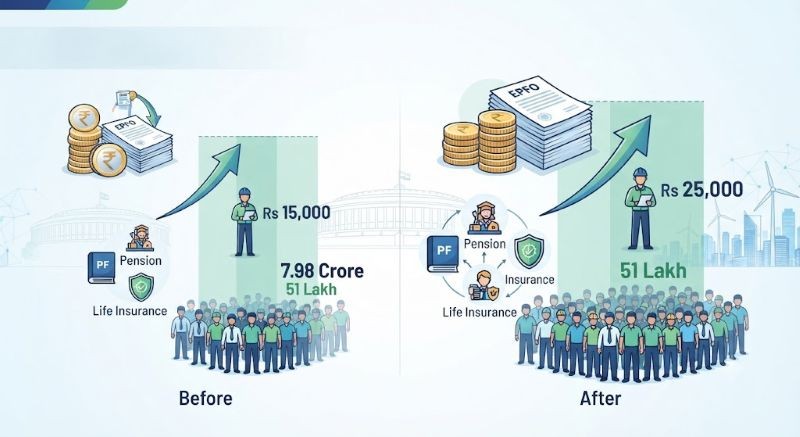
The decision is expected to bring more than 51 lakh additional employees under mandatory EPFO coverage, significantly expanding social security protection for workers.
The EPFO wage ceiling remained unchanged throughout the decade from 2004 to 2014 before being substantially increased to Rs 15,000 in September 2014. The latest decision further raises the ceiling to Rs 25,000, taking into account sustained wage growth, rising incomes and the continued expansion of formal employment, the government said.
At present, employees joining a job at a wage above Rs 15,000 per month are not automatically covered under the EPF framework and may remain outside mandatory provident fund, pension and associated insurance protection. Raising the ceiling to Rs 25,000 will bring a substantial section of employees earning between Rs 15,000 and Rs 25,000 within the statutory social security framework.
The move will expand access to provident fund savings, pension protection under the Employees’ Pension Scheme (EPS) and insurance coverage under the Employees’ Deposit Linked Insurance Scheme (EDLI), subject to applicable scheme provisions.
It will also enable the statutory contribution and pensionable-wage framework to better reflect prevailing wage levels.
Since the wage ceiling was last revised in September 2014, India has witnessed sustained wage growth, rising incomes and continued expansion of formal employment. In several states and occupations, minimum wages have also moved closer to the existing threshold.
The enhancement to Rs 25,000, therefore, updates the EPFO framework in line with prevailing wage levels and extends formal social security benefits to a wider segment of the workforce.
The government said the measure is expected to provide further impetus to employment formalisation, worker retention and long-term retirement security.
By bringing a larger number of employees automatically within the statutory social security framework, the decision strengthens the principle that formal employment should be accompanied by portable and assured social security protection.
For employers, wider social security coverage could also support employee retention, workforce stability and morale, while contributing to a more secure workforce.
The proposal underwent detailed inter-ministerial consultations and was recommended by the Expenditure Finance Committee at its meeting on June 16, 2026.
The annual government expenditure is estimated at around Rs 11,339 crore, compared with the existing annual budgetary support of approximately Rs 10,250 crore. The estimated expenditure over five years is around Rs 56,696 crore.
EPFO operates one of the world's largest social security systems, administering the Employees' Provident Fund (EPF), Employees' Pension Scheme (EPS) and Employees' Deposit Linked Insurance Scheme (EDLI).
According to the latest EPFO data, the organisation has around 7.98 crore contributing members across approximately 7.68 lakh contributing establishments, while the EPS provides pension benefits to around 82 lakh pensioners. EDLI provides insurance protection linked to EPF membership.
India's workforce remains central to its economic growth. As wages rise, incomes improve and formal employment expands, the government has said its focus on employment generation and formalisation is creating new opportunities for workers.
The enhancement of the EPFO wage ceiling is intended to ensure that the social security framework keeps pace with these changes and that a larger number of workers in formal employment receive statutory social security protection.
"This approval marks another important step towards building an inclusive, resilient and future-ready social security architecture, ensuring that social protection advances alongside economic growth, rising wages and expanding formal employment as India moves towards Viksit Bharat@2047," the government statement said.
The Ministry of Labour and Employment and EPFO will undertake the necessary statutory and administrative steps for implementing the decision.