
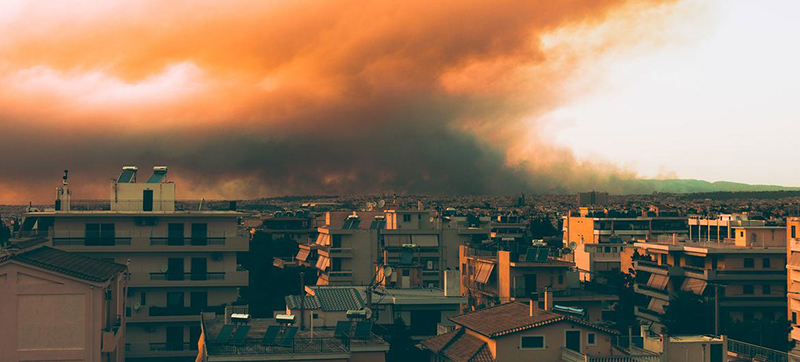
New data published jointly by the World Meteorological Organization (WMO) and the Copernicus Climate Change Service confirmed fears that 2023 was the joint warmest or second warmest year on record in Europe.
In practical terms, this led to a record number of days with “extreme heat stress” across Europe, “an increasing trend” in the number “strong heat stress” days on the Continent and an “extended summer” from June to September, marked by heatwaves, wildfires, droughts and flooding.
“2023 was the joint warmest or second warmest year on record depending on the dataset,” WMO said. “Heat-related mortality has increased by around 30 per cent in the past 20 years and heat-related deaths are estimated to have increased in 94 per cent of the European regions monitored.”
Unenviable record
A precise estimate of heat-related deaths is not yet available for 2023, but WMO noted that between 55,000 and 72,000 people died in heatwaves in 2003, 2010 and 2022.
The findings in the WMO's 2023 European State of the Climate report reflect increasing wider climate change shocks globally, but they are particularly significant because the continent is the fastest-warming, WMO said.
“The climate crisis is the biggest challenge of our generation,” said Celeste Saulo, WMO Secretary-General. “The cost of climate action may seem high but the cost of inaction is much higher. As this report shows, we need to leverage science to provide solutions for the good of society.”
Researchers who tracked back a decade found that members of the public and some health providers also had “a low-risk perception” of the dangers of heat exhaustion. To counter this, early warning systems including the WMO’s Regional Climate Centre’s Climate Watch are designed to raise awareness of impending extreme weather events and encourage preparedness.
According to the UN agency, land temperatures in Europe were above average for 11 months of the year in 2023, including the warmest September on record.
Rainfall was also seven per cent higher than average, WMO’s weather report found, with European rivers flowing at record levels in December and “exceptionally high” flow in almost a quarter of the river network.
This meant that during 2023, “high” flood thresholds were crossed in one third of the European river network, while close to one in seven exceeded “severe” flood thresholds.
‘Beyond extreme’ sea heat spike
Record sea surface temperatures around Europe also reflected the deeply worrying warming trend on land, with an alarming “marine heatwave” present in June, in the Atlantic Ocean west of Ireland and around the United Kingdom. The event was classified as “extreme” and in some areas “beyond extreme”, WMO said, with sea surface temperatures as much as 5 Celsius above average.
“For the year as a whole, the average sea-surface temperature for the ocean across Europe was the warmest on record,” WMO said. “Parts of the Mediterranean Sea and the northeastern Atlantic Ocean saw their highest annual average sea-surface temperature on record.”
In a focus on sustainability and resilience to climate change shocks, the UN agency report underscored a record increase in electricity generation using renewable technology in Europe.
This was linked to higher-than-normal storm activity from October to December, which resulted in above-average wind power production. Also significant was above average hydroelectric power generation across much of Europe over 2023, linked to above-average rainfall and river flow.
On the other hand, solar panel power generation was below average in northwestern and central Europe, but above average in southwestern Europe, southern Europe and Scandinavia.
Fewer snow days
WMO’s State of the Climate update also confirmed suspicions that much of Europe experienced fewer days with snow than average, particularly across central Europe and the Alps over the winter and spring.
This resulted in “exceptional” glacier ice loss in the Alps, made worse by strong summer melt caused by heatwaves, with glaciers losing around 10 per cent of their remaining volume over 2022 and 2023.
Arctic shock
Data for 2023 did little to allay concerns about the earth’s poles, with Arctic temperatures the sixth warmest on record. Breaking this down further, temperatures on Arctic land masses were the fifth warmest on record, closely behind 2022. “The five warmest years on record for Arctic land have all occurred since 2016,” WMO noted.
The fluctuating extent of Arctic Sea remained below average through most of 2023, the UN agency also reported. “At its annual maximum in March, the monthly extent was four per cent below average, ranking fifth lowest on record. At its annual minimum in September, the monthly extent ranked sixth lowest, at 18 per cent below average.”
Persistent wildfire threat
Total wildfire carbon emissions from the sub-Arctic and Arctic regions were the second highest on record in 2023, WMO said, linked to high-latitude wildfires, the majority occurring in Canada between May and September.