
The victims were lynched in April amid unrest in the minority-dominated district during protests opposing the legislation.
The court also directed the West Bengal government to pay compensation of ₹15 lakh to the victims’ family.
“We built the case under seven sections, including mob lynching, rioting, dacoity, house trespass and murder. The court has awarded life imprisonment to all the convicts, along with 10 years’ imprisonment for dacoity and house trespass and five years for rioting,” public prosecutor Bivas Chatterjee told The Hindu.
“A fine of ₹5,000 has been imposed for each offence, and the state has been directed to pay ₹15 lakh as compensation to the victims’ family,” he added.
The Waqf (Amendment) Act, aimed at regulating Waqf properties and addressing alleged irregularities, triggered widespread protests in several parts of the country, particularly in areas with sizeable Muslim populations.
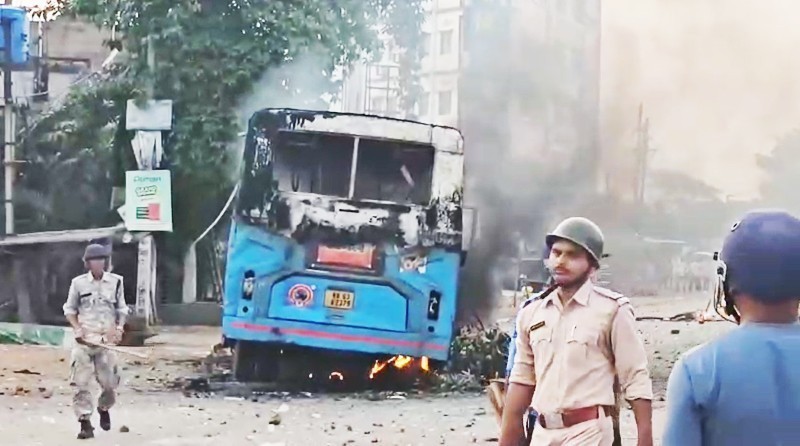
In Murshidabad’s Samserganj and adjoining regions, the demonstrations spiralled into communal violence marked by mob attacks, arson and clashes with the police.
Amid the violence, Haragobindo Das (72) and his son Chandan Das (40), residents of Jafrabad village under Samserganj police station, were brutally killed on April 11–12, 2025. Their bodies were later recovered from their home with multiple stab wounds, indicating they were hacked to death by a mob.
Investigations revealed that a group of assailants had forced entry into the Das family residence and carried out the killings in broad daylight.
The incident was part of a larger bout of violence in Murshidabad district in which at least three people lost their lives, including another individual in Suti who died of a gunshot injury during clashes.
The killings of Haragobindo and Chandan Das emerged as a major flashpoint in the debate over law and order in Murshidabad, with reports highlighting displacement, property damage and heightened communal tensions during the anti-Waqf protests.
The case has also renewed broader discussions on protest management, policing and political accountability in communally sensitive regions.