
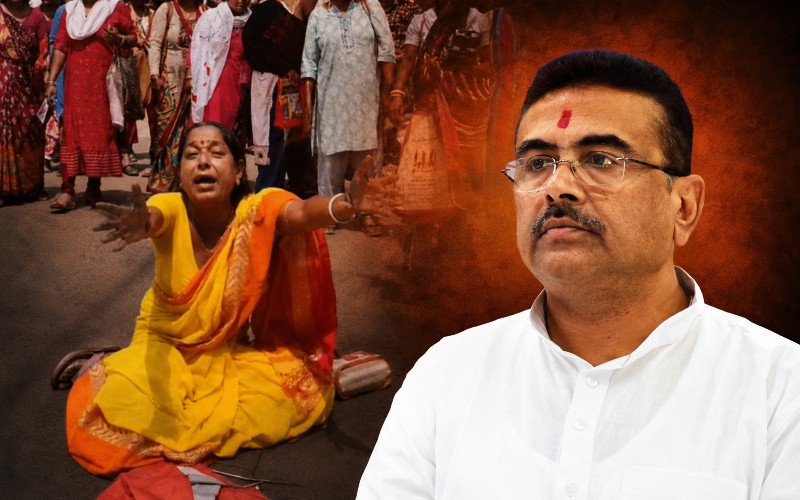
On Friday, women gathered outside district magistrates’ offices, block development offices and even the residences of ministers across the state, demanding answers over their exclusion from the Annapurna Bhandar scheme.
The protests have raised a question that goes beyond the list of beneficiaries: why has a scheme designed to provide financial support to women generated such anger so soon after its rollout?
The immediate dispute centres on eligibility, verification and the exclusion of applicants who expected to receive the benefit.
However, the wider controversy has also exposed questions about the relationship between the BJP-led government and the party organisation that is expected to carry its welfare policies to the grassroots.
A welfare scheme under pressure
The scale of the programme gives the controversy considerable political and administrative significance.
According to the figures cited in the Bengali report, the previous Trinamool Congress government spent around Rs 3,000 crore a month on Lakshmir Bhandar, which covered about two crore women.
Chief Minister Suvendu Adhikari has claimed that around 1.45 crore women have already started receiving payments under Annapurna Bhandar.
That would put the government's monthly expenditure on the new scheme at around Rs 4,500 crore, roughly Rs 1,500 crore more than the earlier expenditure cited for Lakshmir Bhandar.
The dispute is not primarily about whether the government has allocated substantial resources to the scheme. It is about how those resources are being distributed, how eligibility is being established and why a significant number of women who expected assistance have been left outside the initial list.
That distinction is central to understanding the protests.
Organisational gap between govt and party
One of the most significant differences between Annapurna Bhandar and Lakshmir Bhandar lies in the political environment in which the two schemes were introduced.
When Mamata Banerjee's government launched Lakshmir Bhandar, the Trinamool Congress already possessed an extensive grassroots organisation across Bengal.
Party offices operated at ward and booth levels, while local leaders and workers often acted as intermediaries between beneficiaries and the administration.
For applicants struggling with forms, documentation or procedural requirements, local party workers could assist.
Government initiatives such as Duare Sarkar and Para-e Samadhan also created additional channels through which people could access state services.
Annapurna Bhandar is nothing but a scam, leaving lakhs of women across the state struggling while the concerned Minister appears to be completely missing in action, whiling away her time in Kolkata instead of answering the people who are demanding accountability.
— Syed Faisal Iqbal (@SyedF_official) August 20, 2026
This is what… pic.twitter.com/ZRUTvJujhK
Whether one agrees with the Trinamool Congress's political approach or not, its organisational structure had created a mechanism through which welfare schemes could be taken closer to households.
The BJP's position is different. It now controls the state government, but the party's grassroots structure has not necessarily developed at the same pace as its political rise.
That gap has become particularly visible in the Annapurna Bhandar rollout.
The government can establish eligibility criteria, but those criteria have to be communicated effectively to potential beneficiaries.
For economically disadvantaged women unfamiliar with online applications, income documentation and government portals, the process has become difficult to navigate.
Without an effective local support network to explain eligibility requirements, identify necessary documents and help applicants correct errors, the administrative process has itself become a source of frustration.
The resulting conflict is not simply between beneficiaries and the government. It also reflects the absence of an effective political and administrative bridge between policy and the people expected to benefit from it.
Did the govt move too quickly?
The second major issue raised by the controversy is the speed with which Annapurna Bhandar was introduced.
The scheme formed part of the BJP's electoral promises, and after coming to power, the new administration had a clear political incentive to demonstrate that its commitments would be implemented quickly.
That urgency could be particularly strong for a government that has come to power after a change in political regime.
Women blocked the railway tracks at Birati, Kolkata- protesting over not receiving the Annapurna Bhandar funds. pic.twitter.com/A0iGx4Qdpu
— সাবির (@SabirAl72017365) August 21, 2026
New administrations often seek to establish their identity through early policy decisions and visible implementation.
But welfare schemes involving millions of beneficiaries require extensive groundwork — eligibility rules have to be finalised, applications collected, documents verified and databases checked before payments begin.
Some social welfare analysts suggest that the government could have used a longer transition period instead of moving directly from the electoral promise to implementation.
They said one approach would be to continue Lakshmir Bhandar during the initial months of the new administration while simultaneously accepting and scrutinising applications for Annapurna Bhandar, and the government could then have finalised the beneficiary database before beginning payments under the new scheme.
Such a process, the analysts argue, could have reduced confusion and allowed applicants to understand the eligibility criteria before the final list was prepared.
The speed of implementation has consequently become part of the political debate surrounding the protests.
দিকে দিকে বাড়ছে ক্ষোভ! অন্নপূর্ণার টাকা পাইনি কেন? মন্ত্রী অগ্নিমিত্রাকে সামনে পেয়ে ফুঁসে উঠলেন মহিলারা | দৈনিক সমাচার
— Doinik Samachar (@DoinikSamachar) August 21, 2026
Agnimitra Paul | Annapurna Bhandar | Doinik Samachar | Samachar Media Group | #AgnimitraPaul | #AnnapurnaBhandar | #DoinikSamachar pic.twitter.com/3zUDygWwSW
Questions over beneficiary verification
The controversy does not end with women who were excluded from the scheme.
As per local media reports, some women who may not meet the stated eligibility criteria have nevertheless received Annapurna Bhandar benefits, while others who appear to satisfy the government's criteria have been left out.
If the reports are accurate, the problem extends beyond complaints from excluded applicants and raises questions about the verification mechanism itself.
A welfare programme based on defined economic criteria depends heavily on the accuracy of its beneficiary database.
If eligible people are excluded while ineligible applicants are included, public confidence in the criteria and the verification process can both come under pressure.
That creates a difficult position for the government.
Responding to protests by expanding the beneficiary list indiscriminately could undermine the eligibility framework on which the scheme is based.
At the same time, treating the existing list as final despite credible complaints could leave genuine beneficiaries without assistance.
The issue requires scrutiny of individual applications as well as the broader verification system.
ঠকিয়েছে বিজেপি? ভোটের আগে কেন বলা হয়নি তিনটি ঘর থাকলে দেওয়া হবেনা অন্নপূর্ণা ভাণ্ডার? ক্ষোভ প্রকাশ মহিলার | দৈনিক সমাচার
— Doinik Samachar (@DoinikSamachar) August 21, 2026
BJP | Annapurna Bhandar | Womens Protest | Doinik Samachar | Samachar Media Group | #BJP | #AnnapurnaBhandar | #WomensProtest | #DoinikSamachar pic.twitter.com/y48wuYPQ6h
The machinery behind welfare delivery
Another concern is the condition of the administrative machinery responsible for implementing large welfare programmes.
Schemes such as Lakshmir Bhandar and the rural employment guarantee programme ultimately depend on officials and administrative workers operating at the lowest levels of government.
The final stage of implementation often takes place far away from the offices where policies are announced, and parts of this administrative structure, according to local media reports, have been weakened over time by allegations of irregularities, corruption, negligence and political interference.
For a new government, simply introducing a new welfare scheme through the existing machinery can reproduce some of the weaknesses of the old system.
The Annapurna Bhandar controversy has consequently brought attention not only to the beneficiary list but also to the machinery responsible for preparing and maintaining it.
Why protests cannot simply be dismissed
The widespread demonstrations present the BJP government with a politically sensitive challenge.
According to political analysts, dismissing the protests entirely as opposition mobilisation would risk overlooking genuine complaints from women who may have been wrongly excluded from the scheme, and at the same time, bringing every protesting applicant into the programme without checking eligibility could weaken the policy framework itself.
👉 Total number of women voters in 2026 election = 3.1 crore
— WB Youth Congress (@IYCWestBengal) July 3, 2026
Now, new BJP govt launches “Annapurna Bhandar”
👉 Total applications = 1.6 crore
👉 Total REJECTED = 26 lakh
👉 Actual beneficiaries = 1.3 crore
Almost 60% women beneficiaries in Bengal DELETED! Women started protest pic.twitter.com/tycSMiGV3E
The immediate administrative task is to examine complaints individually, identify cases in which eligible applicants were excluded, determine whether ineligible beneficiaries entered the list and establish whether procedural or verification errors contributed to the problem.
Where mistakes are identified, the beneficiary database may require correction.
But the political pressure also raises a larger question about the government's ability to defend difficult policy decisions once they generate resistance.
Annapurna Bhandar tests more than the govt
The controversy has placed the performance of the Suvendu Adhikari government under scrutiny, but it has also exposed the BJP's organisational challenge in Bengal.
"A political party that controls the government needs more than rallies, speeches and electoral campaigns," a Bengal-based political analyst said. "Its local organisation must be capable of communicating government policies, helping citizens navigate administrative processes and carrying public grievances back to the administration."
That role becomes especially important for welfare schemes that involve millions of potential beneficiaries.
The BJP's organisational performance was already under scrutiny during the Assembly election, when reports emerged of difficulties in deploying polling agents at several booths.
The question now is whether the party has substantially strengthened its grassroots structure since taking office.
A test of policy delivery and political organisation
The Annapurna Bhandar controversy has developed into something larger than a dispute over a welfare payment.
At the administrative level, it has raised questions about beneficiary identification, documentation, verification and the capacity of the state's delivery system.
Meanwhile, at the political level, it has tested whether the BJP's organisation can perform the grassroots role that the Trinamool Congress built around its welfare programmes.
The intense protest by women outside the residence of the State Minister for Women and Child Development and Social Welfare, Malati Rava Roy, regarding the non-payment of Annapurna Bhandar benefits, clearly exposes the structural failure of the BJP administration. Defrauding… pic.twitter.com/xBaqty2s8V
— Akbar sekh (@akbarsekhaitc) August 20, 2026
For the government, the challenge lies in dealing with complaints without abandoning the eligibility framework that underpins the scheme, while for the BJP, the episode has highlighted the importance of building an organisational structure capable of connecting government decisions with citizens at the neighbourhood and booth level.
The protests have brought those two challenges together in a single welfare programme, making Annapurna Bhandar an early test of how the new administration translates a major electoral promise into a functioning system of public delivery.