
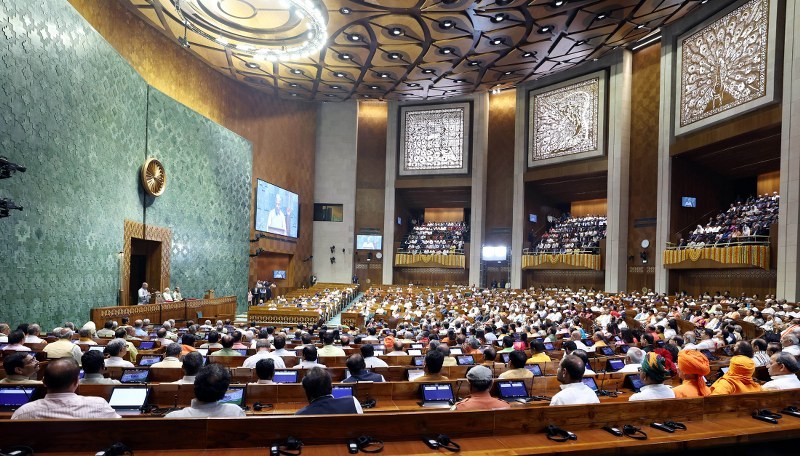
The Lok Sabha will reconvene on November 30, while the Rajya Sabha is scheduled to meet on December 2, Parliamentary Affairs Minister Kiren Rijiju announced on Thursday.
The government has asked the respective presiding officers to reconvene the Houses to transact essential government business.
The sittings are expected to conclude by December 3, with only a limited number of days allotted to each House.
The move effectively extends the Monsoon Session, which has remained suspended since August without being formally prorogued.
The government is seeking to revive legislation that failed to secure the required two-thirds majority in the Lok Sabha in April, when its proposed delimitation exercise and related constitutional amendments were defeated.
Delimitation and women's reservation at the centre of debate
The government's proposed legislative package seeks to expand and redraw parliamentary constituencies, paving the way for the implementation of the 33 per cent reservation for women provided under the Nari Shakti Vandan Adhiniyam, passed in 2023.
Although Rijiju did not specify the agenda for the upcoming sittings, sources said a Cabinet meeting scheduled for Friday is likely to consider the delimitation bill.
On Constitution Day, Home Minister Amit Shah reiterated the government's commitment to implementing women's reservation, asserting that neither the BJP nor Prime Minister Narendra Modi would allow the initiative to be blocked. Modi also echoed the sentiment.
The Opposition, led by the Congress, has argued that women's reservation should be implemented within the existing Lok Sabha strength of 543 rather than being linked to a sweeping delimitation exercise that could alter the political balance among states.
What the proposed delimitation bills entail
Under the proposed legislation, the Lok Sabha's strength would increase from 543 to 850 seats, with approximately 283 seats reserved for women on a rotational basis.
The exercise would also involve reallocating seats among states based on the 2011 Census, or another census selected by the government, rather than waiting for the completion of Census 2027.
The government has verbally assured parties that the increase in seats would be a uniform 50 per cent across states to preserve the existing political balance.
However, the assurance was not incorporated into the original bill's text, a key point of contention during the April debate.
NDA's numbers game ahead of Parliament session
The government is reportedly working to bridge the gap between its current strength and the two-thirds majority required to pass constitutional amendments.
NDA floor managers estimate that the alliance has the backing of around 319 MPs, including 241 from the BJP.
A reported 20-member breakaway group of the Trinamool Congress, which has joined the little-known NCPI, has reportedly figured in the government's calculations.
With the eight MPs of the NCP (Sharadchandra Pawar) potentially backing the proposal, the tally could rise to 327. NCP-SP leader Supriya Sule has indicated that her party would support the legislation if all states receive a uniform 50 per cent increase in seats, ruling out any regional bias.
The DMK's 22 MPs could further push the tally to 350, although the party has yet to clarify its position on the government's proposal. The remaining support would have to come from MPs outside the NDA and INDIA blocs.
Opposition sets four conditions
The Congress-led INDIA bloc, the DMK and the Aam Aadmi Party have outlined four conditions for supporting the legislation:
- The Lok Sabha's strength must remain at 543.
- States must retain their existing number of parliamentary seats.
- The 33 per cent women's quota must be implemented within the existing House strength, translating to 182 reserved seats.
- The arrangement must be protected through a constitutional amendment for 25 years.
Opposition leaders have indicated they would support the bills if the government accepts these conditions, which would effectively abandon its proposed expansion and redrawing of constituencies.
The Congress has maintained that it is not opposed to delimitation in principle but insists that the exercise must be carried out in accordance with constitutional provisions and through consensus.
Party president Mallikarjun Kharge has repeatedly sought an all-party meeting with Prime Minister Narendra Modi to discuss the issue.
While the government has accused the Opposition of obstructing women's empowerment, opposition parties have alleged that the women's quota is being used as a justification for politically advantageous constituency restructuring.
A record parliamentary gap and the 2029 deadline
The gap between the last sitting of the Monsoon Session and its planned reconvening on November 30 will stretch to 108 days, surpassing the previous record of 87 days set in 2008.
Since the session was not formally prorogued, Parliament can be reconvened at short notice. A fresh session following prorogation would ordinarily require a longer notice period.
The timing is crucial for the government. If the delimitation and related constitutional amendments fail to pass during the upcoming sittings, implementing the revised constituencies and women's reservation in time for the 2029 Lok Sabha elections could become increasingly difficult.