
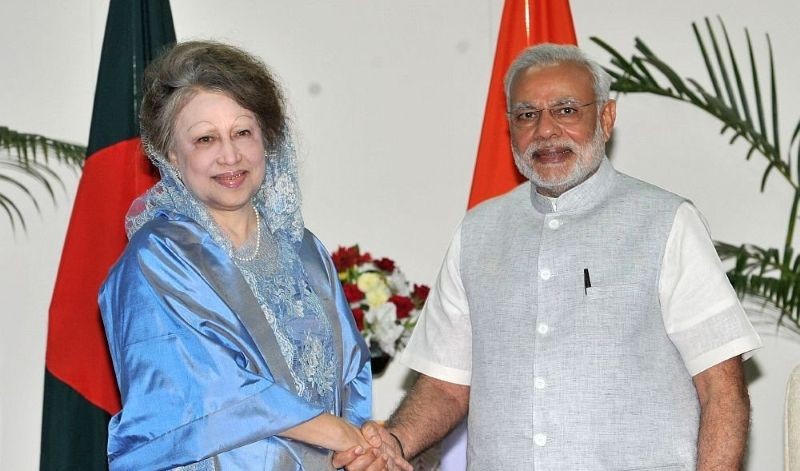
In a post on X, PM Modi acknowledged Khaleda Zia’s contributions to Bangladesh’s development and her role in strengthening India-Bangladesh relations.
“Deeply saddened to learn about the passing away of former Prime Minister and BNP Chairperson Begum Khaleda Zia in Dhaka. Our sincerest condolences to her family and all the people of Bangladesh. May the Almighty grant her family the fortitude to bear this tragic loss,” Modi wrote.
“As the first woman Prime Minister of Bangladesh, her important contributions towards the development of Bangladesh, as well as India-Bangladesh relations, will always be remembered. I recall my warm meeting with her in Dhaka in 2015. We hope that her vision and legacy will continue to guide our partnership. May her soul rest in peace,” the Prime Minister added.
Deeply saddened to learn about the passing away of former Prime Minister and BNP Chairperson Begum Khaleda Zia in Dhaka.
— Narendra Modi (@narendramodi) December 30, 2025
Our sincerest condolences to her family and all the people of Bangladesh. May the Almighty grant her family the fortitude to bear this tragic loss.
As the… pic.twitter.com/BLg6K52vak
The Bangladesh Nationalist Party (BNP) confirmed that the country’s first woman Prime Minister died at 6 a.m., shortly after the Fajr prayer.
In a post on X, the BNP said: “The BNP Chairperson and former Prime Minister, Begum Khaleda Zia, passed away today at 6:00 a.m., shortly after the Fajr prayer. Inna lillahi wa inna ilayhi raji‘un. We pray for the forgiveness of her soul and request everyone to offer prayers for her departed soul.”
The BNP Chairperson and former Prime Minister, Begum Khaleda Zia, passed away today at 6:00 a.m., shortly after the Fajr prayer. Inna lillahi wa inna ilayhi raji‘un. We pray for the forgiveness of her soul and request everyone to offer prayers for her departed soul. pic.twitter.com/KY2948UPD5
— Bangladesh Nationalist Party-BNP (@bdbnp78) December 30, 2025
Zia was undergoing treatment at Evercare Hospital in Dhaka. She passed away in the presence of family members, including her eldest son and BNP acting chairman Tarique Rahman, who had returned to Bangladesh from London, where he had been living in exile since 2008.
Born on August 15, 1945, Khaleda Zia was the widow of former President Ziaur Rahman, the founder of the BNP, which she later led to national prominence.
She entered politics following her husband’s assassination in 1981 and gradually rose as a key opposition leader during Bangladesh’s movement against military rule.
In 1991, Khaleda Zia became Bangladesh’s first woman Prime Minister, serving two terms from 1991–1996 and 2001–2006. Her administrations focused on restoring parliamentary democracy, economic liberalisation and infrastructure development.
For decades, Bangladeshi politics was dominated by her intense rivalry with Sheikh Hasina, leader of the Awami League, a phase often referred to as the era of “Begum politics.”
In her later years, Khaleda Zia faced multiple corruption cases that led to imprisonment, while prolonged health issues kept her largely out of active politics.