
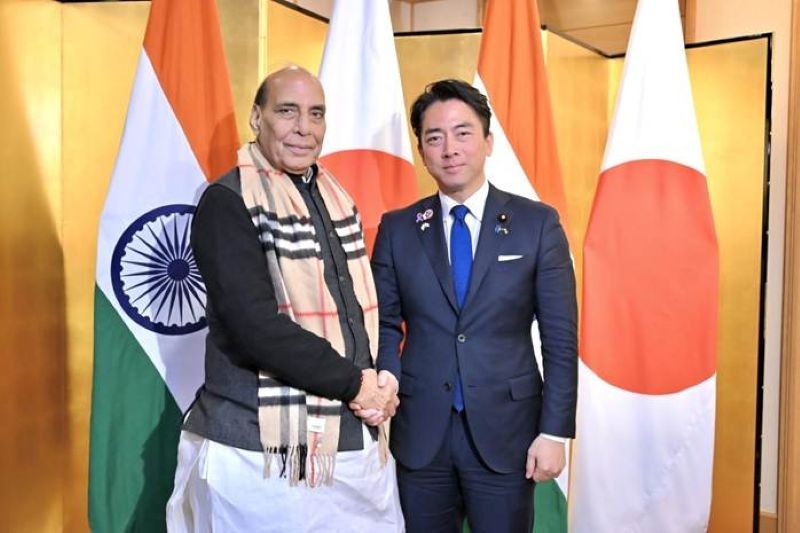
Both ministers welcomed the signing of a Letter of Intent (LoI) on the utilisation of firing ranges in India by Japan's Self-Defense Forces. Under the arrangement, Japanese forces will, for the first time, conduct live-fire training exercises at Indian firing ranges, including drills involving surface-to-ship missiles.
They agreed to accelerate coordination between the defence authorities of the two countries to facilitate the early implementation of the initiative.
The ministers also welcomed progress in maritime security cooperation under the Memorandum of Arrangement on Maritime Security Cooperation, signed in August this year.
In this regard, they confirmed that a working group, headed at the Joint Secretary/Director General (JS/DG) level, would follow up on discussions covering areas such as strengthening mine countermeasure capabilities and exploring the possibility of joint development in naval shipbuilding and design.
They further agreed to deepen cooperation to create an environment conducive to information sharing between the Japan Maritime Self-Defense Force and the Indian Navy.
The two ministers welcomed expanding defence ties through joint military exercises, including the multilateral naval exercise Malabar 2026, involving Japan, the United States, India and Australia, and the Japan-India Maritime Exercise (JAIMEX26), both conducted in Japan this month. They also agreed to further strengthen exchanges between their respective Special Operations Forces.
On defence equipment and technology cooperation, the ministers expressed hope for an early conclusion of the arrangements related to the UNICORN project and India's Acceptance of Necessity (AoN) by February 2027.
They also reaffirmed their commitment to advancing defence research and development cooperation between India's Defence Research and Development Organisation (DRDO) and Japan's Acquisition, Technology and Logistics Agency (ATLA), particularly in advanced missile and defence technologies.
The ministers also agreed to promote cooperation between the two air services in the field of Air Domain Awareness. They confirmed that discussions at the working level would be taken forward through the JS/DG-level working group.
Against the backdrop of an increasingly complex and uncertain security environment in the Indo-Pacific region, the two leaders agreed to further strengthen multilateral defence cooperation, including trilateral initiatives, alongside bilateral engagement between India and Japan. They also emphasised advancing practical cooperation to promote regional peace and stability.
Both ministers reaffirmed their commitment to implementing the agreed areas of cooperation and taking India-Japan defence ties to greater heights, contributing jointly to peace, stability and prosperity in the Indo-Pacific region