
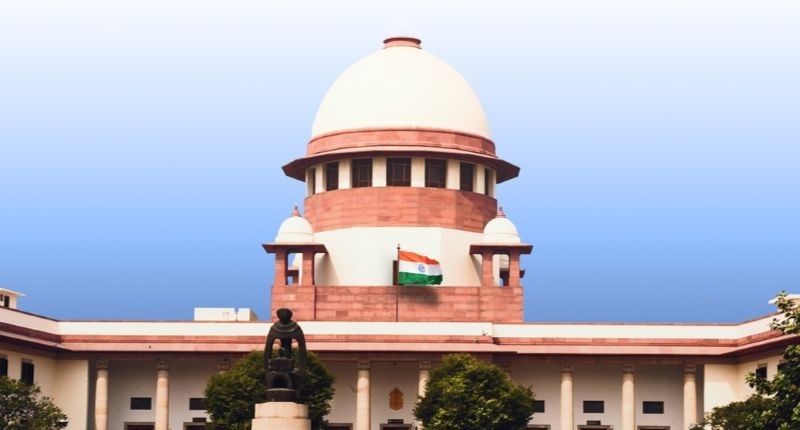
This year, the Hindu festival Basant Panchami coincided with Friday prayers, prompting the court to clarify access.
A bench comprising CJI Surya Kant and Justices Joymalya Bagchi and Vipul M Pancholi ruled that Hindus may offer prayers from sunrise to sunset, while Muslims are allowed from 1 pm to 3 pm.
The district administration has been directed to maintain a list of Muslims who will offer prayers at the site.
The order followed a petition by the Hindu Front for Justice (HFJ), represented by advocate Vishnu Shankar Jain, seeking exclusive rights for Hindus to pray at the complex during Basant Panchami.
HFJ argued that the 2003 Archaeological Survey of India (ASI) report does not address situations when Basant Panchami coincides with Friday prayers.
Bhojshala Temple–Kamal Maula Mosque Dispute — Brief Overview
The Bhojshala–Kamal Maula Mosque dispute centres on a medieval religious site in Dhar district, Madhya Pradesh, that is claimed by both Hindus and Muslims. Hindus regard the site as Bhojshala, an 11th‑century temple dedicated to Goddess Vagdevi (Saraswati), while Muslims identify it as the Kamal Maula Mosque, used historically for Islamic prayers.
Under an Archaeological Survey of India (ASI)–protected status, a longstanding arrangement allows Hindus to perform puja at the site on Tuesdays (and during festivals like Basant Panchami) and Muslims to offer namaz on Fridays.
The dispute has involved legal and archaeological actions, including a Madhya Pradesh High Court order for a scientific ASI survey to clarify the structure’s history and character, and ongoing litigation at the Supreme Court, which has regulated how the survey is conducted and how findings can be used.
Archaeological investigations have reportedly unearthed sculptural fragments and inscriptions that some interpret as evidence of earlier Hindu temple elements, intensifying claims about the site’s origins.