
Yet the image — flames, undergarments, feminist fury — fused into American folklore, and Steinem, as the movement's most photographed face, absorbed the myth whether she liked it or not. She spent decades correcting the record, less out of vanity than principle: precision, to her, was never a small thing.
What made her different from the caricature was not fire but focus. Steinem entered public life as a journalist, not an agitator — a 1963 undercover assignment as a Playboy Bunny exposed the club's underbelly and made her name before feminism did.
That reporter's instinct for evidence over slogan stayed with her for six decades. When she co-founded Ms. magazine in 1971, it wasn't a manifesto so much as an argument built issue by issue, mixing consciousness-raising with pay equity, reproductive rights and domestic violence — subjects newsrooms of the era barely touched.
She could turn a phrase into a movement. "A woman needs a man like a fish needs a bicycle," she was often credited with saying — though she herself noted it originated with Australian writer Irina Dunn, another instance of her insisting on accuracy even when the misattribution flattered her.
Her own lines needed no borrowing: "The truth will set you free, but first it will piss you off." "We've begun to raise daughters more like sons... but few have the courage to raise our sons more like our daughters."
These were not applause lines manufactured for effect; they were arguments compressed, built to survive outside the room they were spoken in.
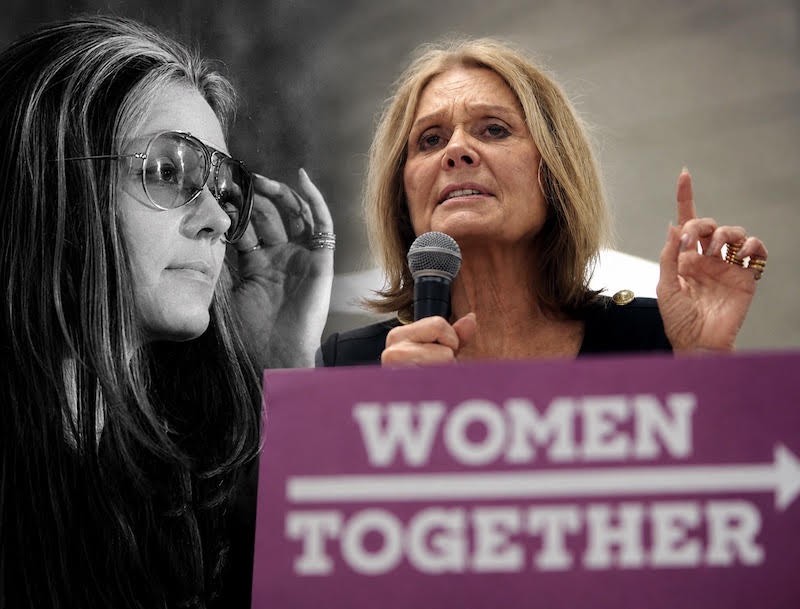
 Gloria Steinem in her younger years. (Photo: Wikipedia)
Was she realistic, or was she simply firepower? The honest answer is both, in proportions that shifted with the moment. Steinem was pragmatic enough to build institutions that outlasted the rhetoric of the era — the National Women's Political Caucus, the Ms. Foundation for Women, the Women's Media Center — organisations designed to keep pressing after the marches ended. She understood, as some of her more incendiary peers did not, that legislation and representation mattered as much as consciousness.
At the same time, she never fully surrendered the firebrand instinct. Her 2016 remark that young women backing Bernie Sanders were doing so because "the boys are with Bernie" drew swift criticism and a swifter apology — a reminder that even a movement's most careful strategist could misjudge a room.
Her politics were never without friction, including within feminism itself. She was criticised at times for a version of the movement seen as centred on white, professional women, a critique she came to acknowledge more directly in later decades, working alongside voices like Dorothy Pitman Hughes and pushing intersectional concerns into rooms that had resisted them. That capacity to be argued with, and occasionally to concede ground, is itself part of what separated her from the myth.
Steinem died days before the scheduled publication of a new memoir, and to the end she remained less a relic of the 1970s than a working argument about what the fight for equality still requires.
President Obama awarded her the Presidential Medal of Freedom in 2013, an honour that formalised what was already true: she had moved from provocateur to institution, without losing the edge that made her provocative in the first place. Her legacy is not a single image of protest but a body of unglamorous, procedural work — magazines, caucuses, foundations — built by someone who understood that outrage without organisation burns out fast.
The trash can in Atlantic City stayed unlit. Gloria Steinem's argument, by contrast, burned for sixty years.