
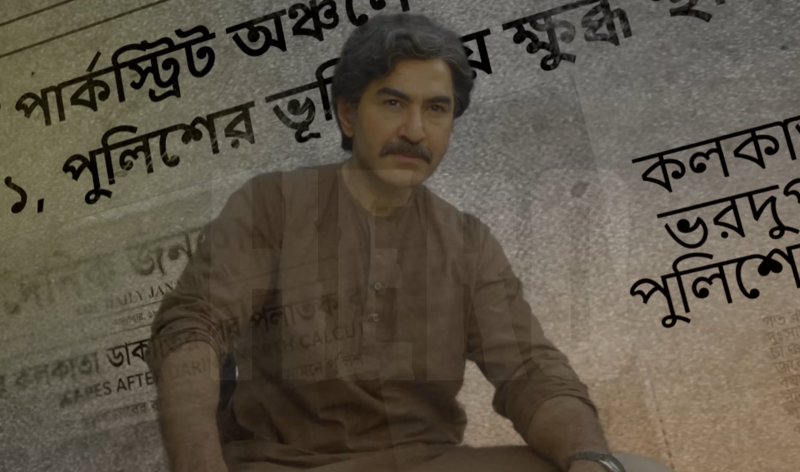
‘Everything about Ananta Singh’s journey excited me’
Q. What drew you to the story of Ananta Singh?
A. Everything about it. I did not know much about him. A couple of times, I had heard about Ananta Singh, but nobody had told me his story or shared any material. Pathikrit Basu asked for an hour of my time and narrated the story to me. I found it fascinating, both the story and the character. The first thing that attracted me was the way the story was woven and how the character evolves through it. That was really exciting for me, and I thought a film should be made on this story and brought to the people.
Everything about Ananta’s journey—his ups and downs, perseverance, struggles and sacrifices—was exciting about this material. So far, we have been able to hold on to the question of whether he was a revolutionary or a dacoit.

‘His fight for independence is still relevant’
Q. Why do you think this story is still relevant at the present time?
A. It is still relevant because Ananta Singh was anti-system. It is the story of a nationalist and his demand for a free India. His fight for independence is so very relevant even now. He left us with a question about whether we got independence in the true sense, and that question is still relevant.
Q. Does this question come to your mind as well?
A. Of course, it does. Sometimes these thoughts do pass through my mind when I feel that we haven’t achieved true independence even after our nation became independent.
‘I always had questions for the director and writing team’
Q. How extensive was your research work to portray Ananta Singh?
A. Thankfully, I had all the material ready. I always had questions for the director and the writing team. I was satisfied when I got convincing answers, but if I didn’t, I used to research more. It is a film that blends facts with fiction to ensure that we didn’t lose out on the entertainment quotient.
Q. How challenging was it to balance the entertainment quotient and the stature of Ananta Singh through acting?
A. Pretty smooth, actually, courtesy of the writing. We really did not have to put in any extra effort. I thoroughly enjoyed it. I would not say it was challenging. I thoroughly enjoyed it because the material provided was very clear.
Moreover, Ananta Singh is a rare revolutionary whose story has a comic side because he had a fun side and used to adopt a lot of disguises.

‘I only read the book on which the film is based’
Q. Beyond the script, did you consult any historians or read any books?
A. No, nothing except the book Keu Bole Biplobi, Keu Bole Dakat, on which the film is based. I had many questions, which I used to ask the director.
‘Pathikrit Basu will surprise those who doubted him’
Q. Was your director Pathikrit Basu intimidated by your stardom?
A. No, no, nothing like that because he has already dealt with superstars like Mithun Chakraborty and Dev. I liked the way he kept things reciprocal and mutual. We used to discuss regularly how our approach should be to the script.
Adding to that, Pathikrit Basu will surprise all those who had raised doubts over him directing this film.
‘It was a great opportunity to portray him’
Q. Take us through your journey of slipping into the various aspects of Ananta Singh’s life.
A. That, again, was in the script. Everything was available in the material. We tried to capture his life spanning from 25 to 69 years. It might be challenging, but it was a great opportunity for me to portray him.
‘Every film comes with its own uniqueness’
Q. How different were the action sequences from your other mainstream films, and did you have to adjust your approach to such scenes?
A. I won’t compare because every film comes with its own uniqueness, and we try to weave action sequences around the story. For this film, it was no different. It is the same approach, only that the action is moved with the story and we kept the period in mind.
Moreover, we had stunt director Stun Shiva from South India. His 25-30 years of experience and his understanding of the requirements of a period film helped us a lot.

‘There was a mental transformation’
Q. Did you have to go through any kind of physical transformation?
A. No physical transformation, but mental transformation was, of course, there. Makeup and costumes played the entire role in the physical transformation.
‘I could connect to his struggles and perseverance’
Q. Did you relate to any of his characteristics?
A. Quite a few things. I could connect to his struggles, perseverance, sacrifices and ups and downs, which we all go through in our lives. I think what he did at that time needed more courage because of the limited facilities back in those days.
So, I enjoyed the process as I could see some similarities in certain aspects.
‘Let people watch it’
Q. The film will definitely start a conversation. Do you feel the audience is ready for it?
A. Let’s see, let people watch it. We still don’t know what they are going to come up with.
‘If it makes a good sound here, it will be in Hindi first’
Q. Do you want this film to be released pan-India?
A. No. As of now, we are releasing it only in Bangla, and we will see if there is an opportunity to release it nationally, but in a vernacular language with subtitles. As of now, we have no such plans.
If we do it after it makes a good sound here, then it will be in Hindi first.

‘I’m happy and proud to be a part of this film’
Q. How do you see this film in terms of being a producer?
A. I’m happy and proud to be a part of this film because I am playing a real-life character whose journey has perhaps not been known to many people, but those who know him have very high regard for Ananta Singh.
Once you know his journey, you’ll be really excited and happy to understand and know about him. So, to me, when it excited me so much on paper, I was happy to be a part of it as a producer.
(Photos: Screen-grab/trailer video)