
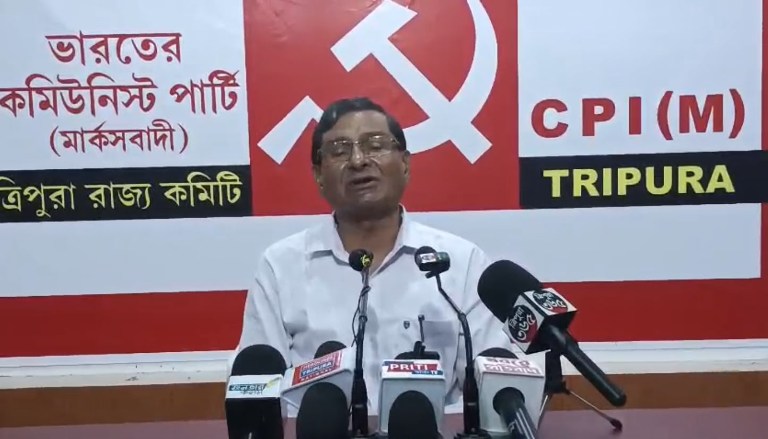
Former Tripura Power Minister and CPI(M) leader Manik Dey has raised questions over the state government’s smart meter rollout, alleging that the power sector is gradually being handed over to private agencies and that consumers could ultimately bear the financial burden.
Addressing a press meet at CPI(M) headquarters in Agartala on Wednesday afternoon, Dey said the government has failed to provide satisfactory answers to growing complaints from consumers over smart meters and increased electricity bills. He maintained that the Left Front government had also introduced smart meters on a limited, experimental basis, but the scale and manner of the present rollout were fundamentally different.
According to Dey, around 40,000–50,000 smart meters were installed experimentally before March 2018, when Tripura had around 7.5 lakh electricity consumers. He said the meters were supplied through tender and installed under the management of the Tripura State Electricity Corporation Limited (TSECL).
“There was no major public dissatisfaction over smart meters at that time,” Dey claimed, arguing that the present situation has changed considerably since 2018.
He alleged that under the current system, private companies are increasingly involved in supplying, installing and maintaining smart meters. This, he said, raises questions about accountability when a meter malfunctions, generates an allegedly excessive bill or needs replacement.
Dey asked whether responsibility in such cases would rest with TSECL, the state government or the private company concerned.
He also alleged that many consumers have complained of receiving significantly higher bills after smart meters were installed despite no substantial change in their electricity consumption. The former minister demanded a transparent mechanism for meter reading, bill calculation and disposal of consumer complaints.
Dey said he was not opposed to technological modernization of the electricity sector but objected to any system that could impose an additional financial burden on ordinary consumers without adequate transparency and accountability.
He demanded an impartial inquiry into complaints surrounding smart meters and urged the government to clearly state who would remain responsible for the supply, installation, maintenance and replacement of meters.
Dey further alleged that the proposed smart meter system could facilitate centralized collection and management of consumer data, including Aadhaar-linked information, through private agencies. He also claimed that the system could eventually facilitate greater private-sector involvement in profitable segments of the electricity sector.
He raised concerns over the proposed “Time-of-Day” tariff mechanism, under which electricity prices could vary according to the time of consumption. Dey argued that higher tariffs during peak hours could place an additional burden on consumers.
The former Power Minister also criticized the alleged delay in implementing a combined-cycle power project that, he said, was planned to generate an additional 80 MW by utilizing heat produced during gas-based power generation.
Dey claimed that around Rs 1,400 crore was proposed to be invested in the project, but work had not begun despite several years having passed since its conception. He questioned the future of the project and sought clarity on the commitments made regarding investment and employment.
He also criticized the government over technical and commercial losses in the power sector. According to him, technical losses can be reduced through replacement and repair of ageing distribution transformers, replacement of worn-out lines, modernization of feeders and equipment, and improvement of substations.
Dey alleged that despite financial assistance from institutions such as the World Bank and Asian Development Bank, technical losses remain a burden on consumers. He also claimed that commercial losses remain high because of faulty meters, delays in meter replacement, power theft and substantial outstanding electricity dues from various government and semi-government institutions, banks and other organizations.
He argued that addressing these issues would reduce the need to increase electricity tariffs.
Dey said that during the Left Front government, TSECL engineers and employees were responsible for installing, repairing and replacing meters whenever consumers raised complaints.
He questioned whether the government had issued any written notification specifying who would be responsible for replacing and maintaining smart meters if a private agency withdrew from the project or its contract ended.
He also claimed that conventional electricity meters earlier cost approximately ₹1,400–₹1,600, whereas smart meters being installed now could cost around ₹8,000–₹10,000, and in some cases up to ₹12,000.
“If such a meter becomes defective in the future, who will bear the cost of replacement?” Dey asked, stressing that the issue could be particularly difficult for economically weaker consumers.
Dey highlighted the expansion of Tripura’s electricity sector during the Left Front period, claiming that the number of consumers increased substantially from around 14,700 in 1978 and that power-generation capacity was eventually raised to around 850 MW.
He said surplus electricity had also been supplied to neighbouring Bangladesh and other markets and claimed that regular load-shedding caused by shortages had effectively been brought under control.
According to Dey, temporary outages caused by natural disasters or technical faults were different from regular load-shedding caused by inadequate power availability.
He alleged that the present move to reduce the role of the state electricity corporation and increase private participation could weaken the government’s direct control over the sector and ultimately transfer additional financial liabilities to consumers.
Dey called for strengthening public-sector institutions rather than relying increasingly on private agencies for essential services.
“Electricity is not a luxury but a basic necessity,” he said, arguing that the sector should be operated in the public interest rather than primarily as a profit-making enterprise.
He urged the government to focus on reducing technical and commercial losses, recovering outstanding bills, preventing power theft and utilizing the expertise of the corporation’s own engineers and employees instead of increasing tariffs to compensate for inefficiencies.
Dey also criticized what he described as excessive dependence on central government policies, saying that a state government should not automatically implement every decision taken by the Centre if it believes such decisions are against public interest.
He questioned whether the government would stand with ordinary consumers or with private and corporate entities seeking to generate profits from essential public services.
Dey ultimately called for strengthening government-owned power institutions such as NTPC and other public-sector power corporations, rather than pushing the electricity sector towards greater privatization.