
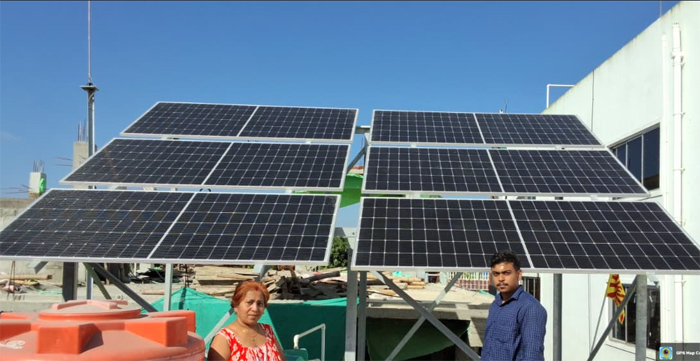
A few solar panels on a household rooftop are quietly changing the way Tripura generates and consumes electricity. The power produced on these rooftops is being used to run household appliances such as lights, fans and refrigerators, while surplus electricity is fed back into the grid. As more households begin generating their own power, the state's electricity landscape is undergoing a transformation that is no longer a distant possibility but a growing reality.
Under the PM Surya Ghar Muft Bijli Yojana, the cumulative installed capacity of rooftop solar systems in Tripura has now crossed the 15 MW mark, signalling a significant shift towards decentralised and renewable energy generation.
The 15 MW milestone is much more than a statistical achievement. It marks the beginning of a new chapter in Tripura's power sector, where electricity generation is no longer confined to large power plants and government-led infrastructure. Thousands of ordinary households across the state are gradually becoming active participants in power generation, turning their rooftops into small, decentralised power stations.
According to data available as of July 27, 2026, a total of 17,330 solar applications have been registered under the scheme in Tripura. Of these, 7,846 applications have been submitted, representing a proposed solar capacity of 24,733 kWp. Solar installations have already been completed in 4,460 households, with a cumulative installed capacity of 15,300 kWp, or 15.3 MW.
The initiative has also delivered significant financial benefits to consumers. So far, 3,853 consumers have received subsidies amounting to more than 32.52 crore. The scheme is therefore helping households move towards clean and renewable energy while also reducing their financial burden on electricity consumption.
The implementation and expansion of the programme are being given priority under the leadership of Tripura State Electricity Corporation Limited (TSECL) Managing Director Biswajit Basu. Under the guidance of Power Minister Ratan Lal Nath and the initiative of Power Secretary Abhishek Singh, IAS, efforts are underway to expand rooftop solar adoption across the state and bring more households under the ambit of renewable energy.
The biggest attraction of the scheme lies in its potential to transform consumers from mere users of electricity into producers of power. Installing a rooftop solar system can help households substantially reduce their electricity bills and, depending on generation and consumption, potentially bring their bills down to zero. Surplus power can also be supplied to the grid, creating an opportunity for additional financial returns.
The impact is already visible. During the quarter from April to June 2026, as many as 1,679 consumers brought their electricity bills down to zero and became eligible to earn a total of 5.79 lakh by supplying surplus electricity generated through their rooftop solar systems. The amount is expected to be credited to the respective consumers' accounts shortly.
The message for electricity consumers is therefore increasingly clear: a vacant rooftop can become a source of power, savings and even additional income. The PM Surya Ghar: Muft Bijli Yojana is creating an opportunity for households to harness the abundant sunlight available in the state and turn it into clean energy for their own use.
The crossing of the 15 MW mark, therefore, is not the end of the journey but the beginning of a much larger transformation. With 4,460 household rooftops already generating electricity, the number is expected to grow substantially in the coming days. If the momentum continues, Tripura's rooftops could gradually evolve into a vast network of small power-generation units, bringing the vision of a cleaner, more self-reliant and decentralised energy future closer to reality.