
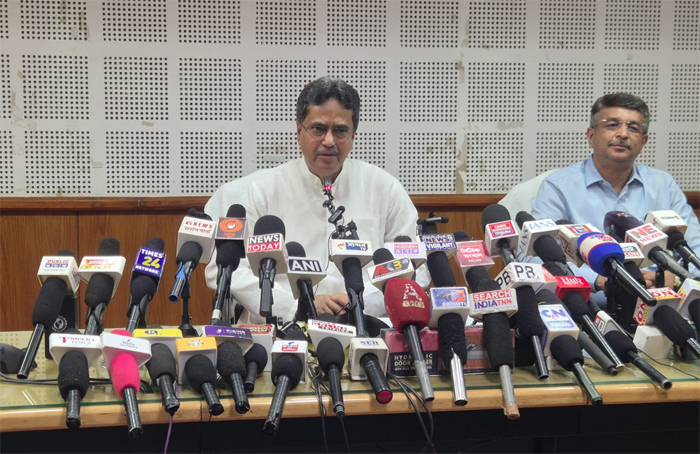
The Tripura Council of Ministers has unanimously adopted a resolution congratulating Prime Minister Narendra Modi on completing 25 years of public service as head of government, from October 7, 2001, to October 7, 2026, and expressing gratitude on behalf of the people of the state.
Chief Minister Prof. (Dr.) Manik Saha announced the Cabinet’s decision at a press conference at the Civil Secretariat on Tuesday afternoon and said that the state government would work shoulder to shoulder with the Prime Minister’s leadership towards building a self-reliant India and a developed Tripura by 2047.
The Chief Minister said Modi assumed office as Gujarat Chief Minister on October 7, 2001, before becoming Prime Minister on May 26, 2014. Throughout his tenure, he said, the principles of “Nation First” and “Citizen First” had remained central to the Prime Minister’s governance, with public service and welfare taking precedence.
Dr Saha highlighted several major decisions taken under Modi’s leadership, including the abrogation of Article 370, the implementation of One Rank One Pension, the creation of the post of Chief of Defence Staff, labour law reforms and the replacement of colonial-era criminal laws with the Bharatiya Nyaya Sanhita.
Referring to national security, the Chief Minister cited the 2016 surgical strikes across the Line of Control, the 2019 Balakot air strikes and Operation Sindoor in May 2025 as examples of the country’s response to terrorism.
He also said India’s global standing had grown significantly over the past 12 years, citing the successful hosting of the G20 Summit in 2023. According to the Chief Minister, 36 countries have so far conferred their highest civilian or national honours on Modi, who has addressed foreign parliaments on 21 occasions.
Dr Saha said Tripura had benefited considerably from the Centre’s development initiatives, particularly in road, rail, air and digital connectivity, healthcare, education, tourism, drinking water supply and energy infrastructure. He described the state as an example of what the Centre and state governments could achieve through coordinated efforts.
Highlighting road infrastructure, the Chief Minister said the Centre had sanctioned six National Highway projects covering a total length of 923 km in Tripura, of which 514 km had already been upgraded to two lanes with paved shoulders. Work on the Agartala City West Bypass had begun to divert heavy vehicles away from the capital’s central areas, while four-laning of the Agartala–Churaibari and Agartala–Udaipur corridors was awaiting project approval.
On railway development, Dr Saha said the Badarpur–Agartala–Sabroom railway line had been fully electrified. Four stations—Dharmanagar, Kumarghat, Udaipur and Agartala—were being redeveloped under the Amrit Bharat Station Scheme at a cost of Rs. 144 crore. The survey for doubling the 263-km Chandranathpur–Sabroom railway line had also been completed.
Agartala’s Maharaja Bir Bikram Manikya Kishore Airport, renamed in 2018, received its new terminal in January 2022. The Chief Minister said the airport had also been declared an international airport and that its air cargo terminal, with an annual capacity of 40,150 metric tonnes, was operational, creating new opportunities for exporting Queen Pineapple, jackfruit and aromatic rice.
Under BharatNet, 714 of Tripura’s 1,178 village panchayats had received direct internet connectivity, including 572 through optical fibre and 142 remote Village Councils through satellite connections, Saha said. He added that 109 telecom sites were operational under the Digital Bharat Nidhi’s 4G Saturation Project, with another 28 remote sites ready for the next phase.
The Chief Minister also highlighted progress under the North East Gas Grid, saying more than 80 per cent of the 253.51-km gas network in Tripura had been completed.
Dr Saha said Tripura had secured the first rank nationally in the Compliance Reduction and Deregulation exercise during 2025 and 2026. Investment intentions and memorandums of understanding worth Rs. 15,300 crore were signed at the Rising North East Business Summit in May 2025, while investment projects worth more than Rs. 8,000 crore had been grounded over the past year.
The Destination Tripura Business Conclave 2026, held in July, attracted investors from across India and 10 foreign countries. A total of 468 MoUs involving proposed investments worth Rs. 1.32 lakh crore had been signed, he said, adding that a special 100-day action plan had been prepared to accelerate the implementation of major projects.
Under the Agartala Smart City Mission, projects covering smart roads, drainage, underground cabling, riverfront development and the renovation of water bodies had improved urban infrastructure. The Rs. 139-crore Integrated Command and Control Centre monitors traffic, public safety and emergencies in real time, the Chief Minister said.
He also cited the development of the Haora Riverfront, renovation of Maharaja Bir Bikram Lake, four-laning of Airport Road and restoration of the Ujjayanta Palace avenue as significant urban development initiatives.
In tourism, Dr Saha highlighted projects at Chabimura, Sonamukhi Eco Accommodation and Adventure Park, Chaturdash Devta Temple, Kasba Kalibari Temple and Dumbur Lake. The Centre had sanctioned more than Rs. 212 crore for the Matabari Tourism Circuit, covering parts of West Tripura, Sepahijala, Gomati and Dhalai districts.
He also noted that Unakoti had been included in UNESCO’s Tentative List of World Heritage Sites in December 2022, opening further opportunities for heritage tourism and local employment.
The Chief Minister said 86.59 per cent of rural households in Tripura had tap water connections under the Jal Jeevan Mission, compared with just over 3.5 per cent when the scheme began in August 2019. Piped water supply had also been ensured in 97 per cent of institutions, including 4,402 schools and 8,550 Anganwadi centres.
In healthcare, around 17 lakh people from 5.5 lakh families had received Ayushman Bharat PM-JAY cards, while more than 5.70 lakh beneficiaries had received cashless treatment, with claims worth Rs. 307 crore settled. The Chief Minister Jan Arogya Yojana covered another 2.70 lakh families, with more than 92,000 beneficiaries receiving cashless treatment.
Saha said the annual MBBS intake in the state had increased from 200 seats in 2022 to 550 in 2026. The Tripura University of Health Sciences had been established to oversee 37 colleges and institutes in the medical and allied health sectors. He also cited 11 successful kidney transplants in the state and the commencement of operations at government homoeopathic and Ayurvedic medical colleges during the 2026–27 academic year.
In education, the Chief Minister said Tripura had become the country’s third fully literate state in the previous year. He also referred to the establishment of several universities and the granting of university status to Women’s College and Tripura Institute of Technology.
Dr Saha said the state had received recognition for its implementation of the PM-JANMAN and Dharti Aaba Janbhagidari Abhiyan initiatives aimed at improving the welfare of indigenous tribal communities.
The Chief Minister said more than 3.5 lakh permanent houses in rural areas and over 80,000 houses in urban areas had been constructed for economically weaker families under the Pradhan Mantri Awas Yojana.
Around 1.40 lakh women in Tripura had become “Lakhpati Didis” through livelihood and empowerment initiatives, he said, adding that self-help groups, Mudra loans and other programmes had supported women’s economic participation.
Under the PM-KISAN Samman Nidhi, Rs. 1,021 crore had been transferred directly to the bank accounts of more than 2.85 lakh farmers. Around 56,600 farmers had received crop loans under the Kisan Credit Card Scheme, while 1.05 lakh farmers were covered under the Pradhan Mantri Fasal Bima Yojana.
Dr Saha also highlighted geographical indication (GI) tags secured for traditional Risa and Rignai textiles, Queen Pineapple, Matabari Peda and Tripura Sarinda, saying these recognitions were helping promote local products and support artisans and farmers.
He cited the development of the Tripura Sundari Temple complex at Udaipur under the PRASAD scheme as another initiative to strengthen religious tourism and preserve the state’s cultural heritage.
The Chief Minister further referred to the Centre’s estimate that 25 crore people across India had moved out of poverty between 2013–14 and 2022–23.
Concluding the press conference, Dr Saha said the Tripura Cabinet had expressed its appreciation for the Prime Minister’s contribution to national development, security, self-reliance and public welfare over the past 25 years.
The Cabinet also reiterated its commitment to working towards the goal of a developed India by 2047 in the spirit of “Sabka Saath, Sabka Vikas, Sabka Vishwas and Sabka Prayas”.
The Council of Ministers extended its best wishes to Modi for his good health and continued service to the nation, expressing confidence that India would continue to progress towards becoming a prosperous, secure, self-reliant and developed country.
Secretary of the Information and Cultural Affairs Department, Kiran Gitte, was also present at the press conference.