
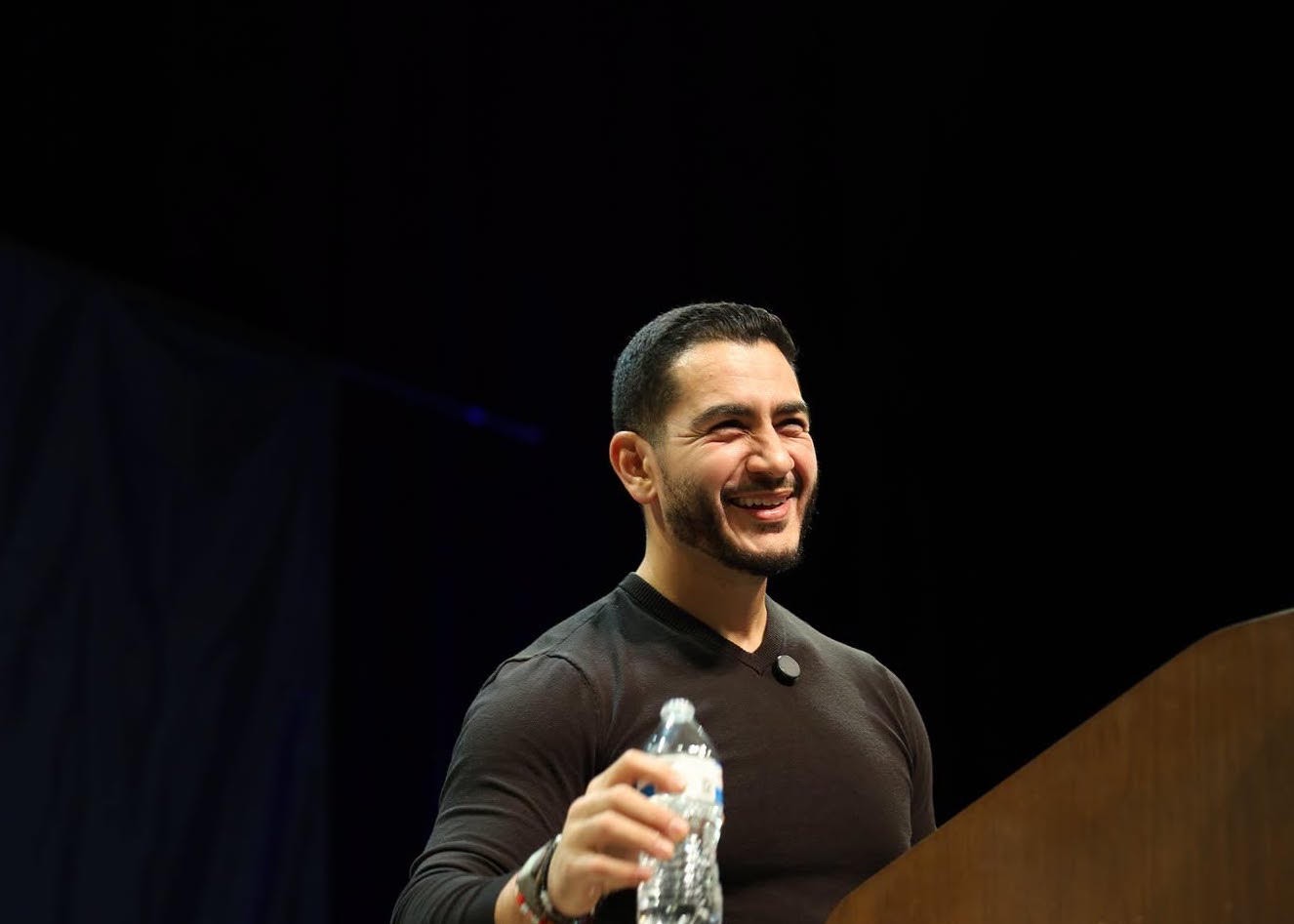
“I’m not turning my back on Democrats,” Stevens said, but she added: “We can’t stand with hate.” El-Sayed accused her of “relitigating a primary that ended three months ago.” Chuck Schumer insists Senate Democrats remain united behind him.
I am endorsing Mike Rogers for the United States Senate today. https://t.co/pQgfSBuhOJ
— Haley Stevens (@HaleyforMI) November 1, 2026
If El-Sayed wins, he would be, by most accounts, the first Muslim in the US Senate. The route runs through a party that cannot decide whether he is its future or its liability.
On Sunday, after Stevens’ endorsement, El-Sayed brushed it off. His line, reported by NBC, CBS and The Hill, was: “At the end of the day, I actually don’t think about Haley Stevens.” He then turned to his larger argument, saying he cares less about “politics” than “policy.”
Abdul El-Sayed is deeply panicked and deeply concerned that Haley Stevens just dropped a nuke on his campaign. "At the end of the day, I actually don't think about Haley Stevens" He won't recover from this. It's over. https://t.co/FxEPpZ2bJf
— Benny Johnson (@bennyjohnson) November 1, 2026
The Ad That Broke the Truce
The rupture began with a grocery-store ad from Rebellion PAC, run by El-Sayed supporter Cenk Uygur, which blamed US aid to Israel for high prices. El-Sayed’s campaign said it was not affiliated with the ad but did not condemn its content.
Stevens, who had backed him since the primary without campaigning beside him, called that inadequate. Last week she urged El-Sayed to “shut out the hate,” and she wrote that “a disclaimer is not a condemnation,” adding that the ad “did not invent its argument” because El-Sayed had made it himself.
Her fiancé and her former campaign chair then announced votes for Rogers. “We’re a household divided,” she told CNN on Wednesday. By Sunday, the household had lost its Democrat.
Both sides deserve criticism here. El-Sayed speaks bluntly on almost everything, yet chose lawyerly distance on the one issue that matters most to Jewish Democrats, then froze out the colleague asking for clarity. Stevens, for her part, said days earlier she would vote for her party’s nominee. Her swing to a Republican in the final 48 hours reads as personal as much as principled.
🚨 BREAKING: Haley Stevens (D) just WALKED OUT to OFFICIALLY endorse Mike Rogers (R) — and he's standing right at her side! "My vote for Senate...MIKE ROGERS." 🇺🇸 "We have to stand with country. WE CAN'T STAND WITH HATE. We can't stand with Hasan Piker!" "I woke up this morning, decided to go to church — and I am here with the person who I am voting for. That is Mike Rogers." 🔥🔥🔥 This is an absolutely amazing sight. Political earthquake happening in MI This is the same Stevens who was supposed to be at a Detroit church today with Jim Clyburn, showing Democratic "unity" behind Abdul El Sayed Abdul ruined THAT
— Eric Daugherty (@EricLDaugh) November 1, 2026
Why He Is Controversial
El-Sayed calls Israel’s conduct in Gaza a genocide, wants to end both offensive and defensive military aid, has called the Israeli government “evil,” and has sidestepped whether Israel has a right to exist as a Jewish state.
He appeared with streamer Hasan Piker, who once said America “deserved” 9/11. After a March attack on a Michigan synagogue he said “hurt people hurt people,” pointing to the suspect’s family losses, then apologised to anyone hurt by the remark.
Over $100,000 in donations came from people affiliated with CAIR, which denies terror links. It is not federally designated, though Florida has designated it.
Sen. John Fetterman said El-Sayed has “a lot of stuff to explain.” To Jewish Democrats, El-Sayed’s own pitch is modest: “We may not agree on everything when it comes to foreign policy.”
The “Taqiyya” Charge
Online and on the right, El-Sayed is accused of taqiyya, hiding his true agenda behind moderate language. The term refers to a doctrine, mainly in Shia jurisprudence, permitting concealment of faith under persecution. Scholars call its modern use a smear implying Muslims, as a class, cannot be trusted.
However, no evidence has been offered that El-Sayed hides anything, and his Israel positions are stated loudly. Critics can attack the views, which are on the record. Alleging concealment adds heat, not substance.
Muslim Rise, Jewish Anxiety
The rise is real. CAIR tracked 76 Muslim candidates in 2025 and more than three dozen won. Zohran Mamdani, of Indian descent, became New York’s first Muslim mayor. Muslim Americans reached Congress only in 2018.
So is the backlash. Trump has called El-Sayed a “jihadist,” and Ted Cruz warned of a “communist with Muslim Brotherhood ties.”
While such attacks target faith rather than policy, liberals call them Islamophobia.
Jewish unease about his Israel record is also genuine, and the community is not monolithic. More than 600 signed a pledge backing him, and Andy Levin, a self-described Zionist, campaigns for him.
Treating his faith as the issue is bigotry, say his supporters.
Sharia is a second flashpoint.
In a 2009 New York Times interview, El-Sayed, then a medical student, described a religious “obligation” to follow Sharia-compliant practice, including taking out a Sharia-compliant mortgage. His campaign says he still observes it personally and that he “believes in the separation of church and state.”
But he has also opposed state bans on Sharia, tying them to white supremacy, and on Fox he likened it to Catholic canon law, saying “nobody is trying to push sharia law on anyone else.”
Critics call that comparison misleading. Republicans, including Trump, claim he wants to impose Sharia. The reporting offers no evidence of that, but his answers left the harder question of where personal observance meets public law unaddressed.
Can He Win?
Polls favour him narrowly: the RealClearPolitics average has him up 5.3 points, CBS/Mitchell has 51% to 44%, and last month’s Fox poll had 50% to 49%. Michigan has not elected a Republican senator since 1994, but Rogers lost narrowly in 2024, older swing voters lean heavily his way, and one pollster warned of late tightening. No poll yet captures the Stevens endorsement.
A win gives Democrats a seat and a test: does the Mamdani template of young, insurgent, unapologetic left populism travel beyond New York? A loss will hand Republicans their argument. Either way, the question of where criticism of a government ends and hostility to a people begins will outlast Tuesday.