
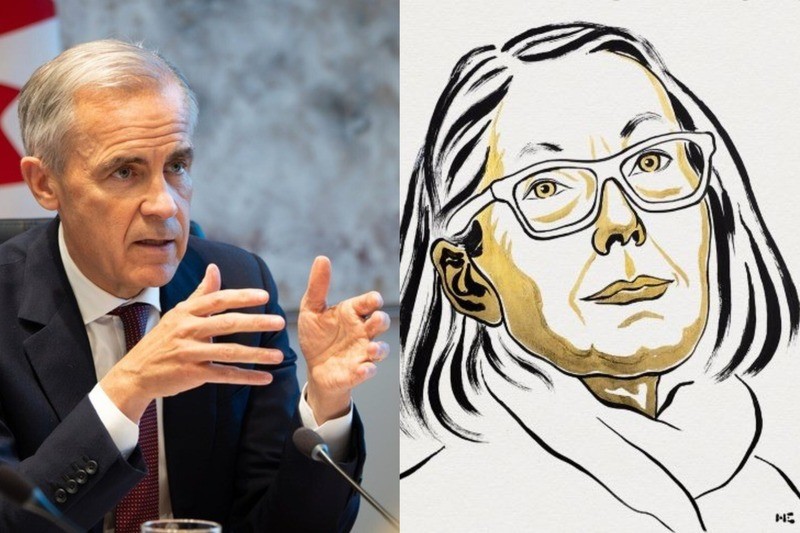
"I congratulate Canadian poet Anne Carson on being awarded the 2026 Nobel Prize in Literature – one of the world’s highest literary honours," Carney said.
He described Carson as "a poet, essayist, translator, and classicist" who "has reimagined the classics with wit, imagination, and a style entirely her own." Carney said she "has brought ancient stories to new audiences and transformed the way we think about literature."
Her work, drawing "on ancient traditions with bold imagination and originality," has "inspired writers and captivated readers around the world," he said.
He noted her earlier distinctions, including two Griffin Poetry Prizes and her appointment as a Member of the Order of Canada.
The Academy’s citation
The Swedish Academy announced the prize earlier in the day. It honoured Carson, 76, "for her bold and inventive oeuvre that, in playful dialogue with the classical tradition, has created new forms for contemporary literature."
In a video shared on the Nobel Prize’s account on X, Carson appeared visibly surprised as she reacted to the news from her kitchen in Reykjavík, Iceland, where she was in the middle of a phone call.
A writer who resists categories
Carson’s work combines poetry, fiction, essays, classical scholarship, translation and drama, and does not fit easily into one genre. Ancient Greek literature, particularly the work of poets and playwrights such as Sappho, has been a major influence.
Her writing often explores love, desire, loss, grief, loneliness, memory and the difficulty of understanding another person.
She moves frequently between scholarship, poetry and personal reflection, setting classical literature beside contemporary life. Her style is often described as intellectually demanding, fragmented and experimental, and she tends to avoid conventional literary forms.
Carson gained wide recognition with Autobiography of Red (1998), a book that blends poetry, fiction and mythology to reimagine the Greek figure Geryon as a contemporary red-winged boy.
Another major work, Nox (2010), is an experimental elegy for her brother Michael. It is designed as a box-like accordion book that gathers photographs, fragments of writing, translations and memories.
Beyond the Griffin prizes, she has also received the Princess of Asturias Award for Literature and a MacArthur Fellowship.