
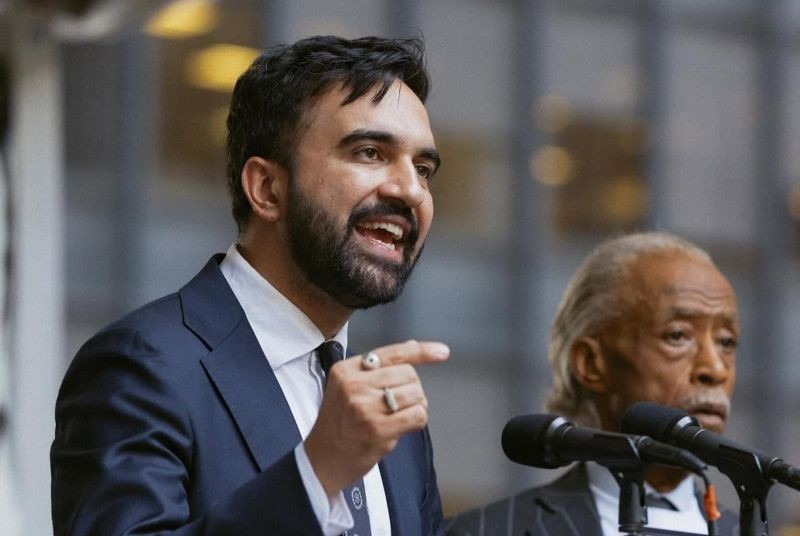
Mamdani and NYC Schools Chancellor Kamar Samuels have announced a one-year moratorium on student-facing generative AI for the 2026–27 school year, with the policy aimed at protecting students' critical thinking, creativity and ability to learn independently.
The restrictions apply to students from 2-K through Grade 8 and affect nearly 600,000 public-school students, or roughly two-thirds of New York City's public-school system.
Mamdani said the policy is based on the principle that children need teachers, human interaction and the experience of working through difficult problems themselves, rather than relying on AI to do the thinking for them.
What is banned?
Under the new policy, student-facing generative AI will be prohibited for students from 2-K through Grade 8.
The restrictions include:
- Student-facing generative AI software
- AI-powered tutors and other AI functions that directly interact with students
- AI companion chatbots across all grades, including high school
In addition, more than 38 previously approved educational programmes containing AI components that do not meet the city's new standards will either have those AI features disabled or be discontinued.
The policy is a one-year moratorium, rather than a permanent ban. New York City officials will evaluate its impact during the 2026–27 school year before deciding whether to extend or modify the restrictions.
What about high-school students?
High-school students will not face a blanket ban on AI.
Instead, the city plans to introduce AI literacy education alongside a limited number of supervised AI programmes.
Every high-school student will receive two 45-minute AI literacy modules each year. The lessons will cover areas including:
- How AI works
- AI bias
- Data privacy
- Misinformation and other risks
- Ethical issues surrounding AI
- Responsible use of AI
- The impact of AI on careers and future skills
Five AI programmes to be tested
The city will also allow five carefully vetted AI programmes to be piloted in selected high-school classrooms.
The pilots will:
- Be available in no more than five classes per high school
- Operate under direct teacher supervision
- Have clearly defined educational objectives
- Be limited to 45 minutes per week
- Use tools that have undergone safety and data-privacy checks
- Ensure that students, rather than AI systems, remain the primary thinkers and decision-makers
Mamdani has clarified that these pilots will not introduce ChatGPT, Claude or similar general-purpose AI chatbots into the curriculum.
Can teachers use AI?
The restrictions do not amount to a blanket ban on AI for teachers.
Teachers can continue using AI for lesson planning and certain operational tasks, provided the tools comply with NYC Public Schools' safety and privacy requirements.
The policy also provides exceptions for certain uses involving students with disabilities, English-language and multilingual learners, as well as career-readiness programmes such as computer science and other career and technical education (CTE) pathways where AI skills are considered relevant.
Why is Mamdani restricting AI?
Mamdani's policy does not seek to remove AI entirely from education. Instead, his administration argues that younger students should first develop foundational skills, creativity, curiosity and critical-thinking abilities through interaction with teachers and classmates.
The Mayor has argued that children will eventually need to understand and use AI, but that does not necessarily mean they should be exposed to generative AI from their earliest years of schooling.
Mamdani has also said he has not seen convincing evidence that generative AI provides sufficient educational benefits for elementary and middle-school students to justify widespread use.
He has raised concerns about research promoting AI in education when such studies are funded by companies that could financially benefit from greater adoption of the technology.