
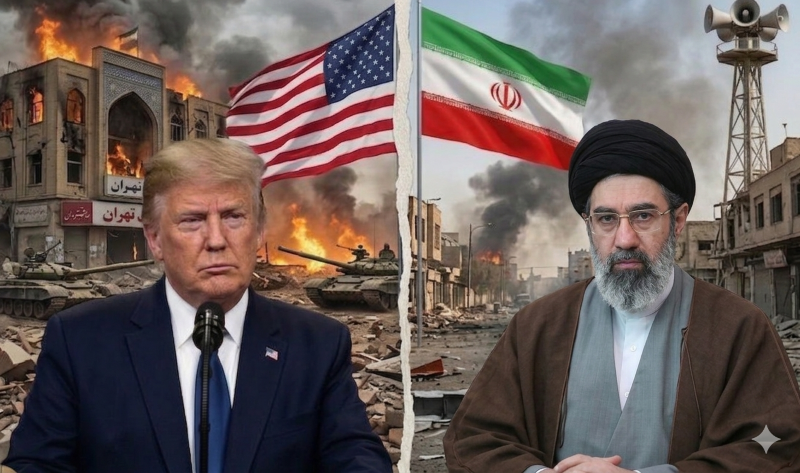
In a statement carried by state broadcaster Islamic Republic of Iran Broadcasting and reported by Anadolu Agency, the IRGC said maritime security in the Gulf and the Sea of Oman “is either for everyone or for no one.”
“The armed forces consider defending the country’s legal rights a natural and lawful duty. Exercising sovereignty over Iran’s territorial waters is a fundamental right of the Iranian nation,” the statement said.
Iran also condemned the US action, calling the restrictions on maritime movement in international waters “illegal” and tantamount to piracy.
US announces naval blockade
US President Donald Trump said the US Navy would begin blocking maritime traffic linked to Iranian ports after Tehran allegedly refused to abandon its nuclear ambitions during high-level talks held in Pakistan.
Posting on Truth Social, Trump said negotiations—lasting nearly 20 hours—collapsed over Iran’s nuclear programme.
“Iran is unwilling to give up its nuclear ambitions… the only point that really mattered was not agreed,” he wrote.
Warning of military action
Trump also issued a stark warning, saying US forces would take direct action if provoked.
“We will also begin destroying the mines the Iranians laid in the straits. Any Iranian who fires at us, or at peaceful vessels, will be blown to hell,” he said.
He further claimed that multiple countries would support the blockade and accused Iran of engaging in “illegal extortion” along key maritime routes.
Iran says deal was close
Iranian Foreign Minister Seyed Abbas Araghchi said an agreement with the US was “inches away” before talks broke down, blaming what he described as “maximalism, shifting goalposts, and blockade.”
In intensive talks at highest level in 47 years, Iran engaged with U.S in good faith to end war.
— Seyed Abbas Araghchi (@araghchi) April 12, 2026
But when just inches away from "Islamabad MoU", we encountered maximalism, shifting goalposts, and blockade.
Zero lessons earned
Good will begets good will.
Enmity begets enmity.
In a post on X, he said Iran had negotiated in good faith during “intensive talks at the highest level in 47 years,” but added: “Zero lessons earned.”
CENTCOM on enforcement
The United States Central Command (CENTCOM) confirmed that it would begin enforcing the blockade from 10 a.m. on April 13.
— U.S. Central Command (@CENTCOM) April 12, 2026
According to the statement, the restrictions apply to vessels of all nations entering or leaving Iranian ports in the Persian Gulf and Gulf of Oman, while ensuring freedom of navigation for ships transiting the Strait of Hormuz to and from non-Iranian ports.