
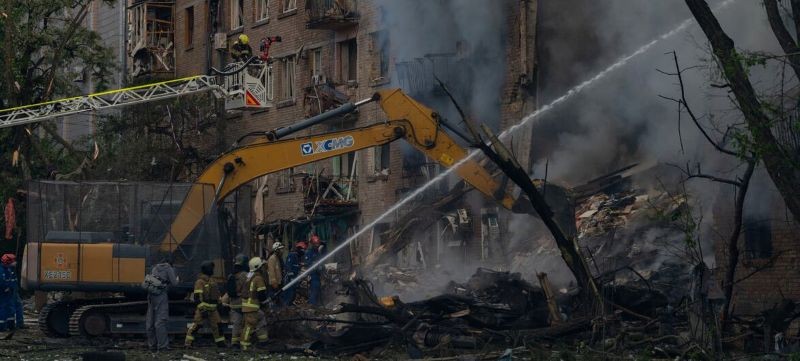
Ukrainian authorities said at least four people were killed and more than 80 others injured. Multiple residential buildings, schools, and a water supply facility were damaged, while a local market was also set ablaze in the attacks.
During another night of horror, attacks in #Ukraine reportedly injured 12 children, including in #Kyiv #Odesa #Nikopol #Cherkasy and #Sumy.
— UNICEF Ukraine (@UNICEF_UA) May 24, 2026
In the capital, relentless attacks hit districts across the city, devastating lives and family homes. pic.twitter.com/qSDRDlmaFx
Unverified footage circulating on social media appears to show a missile striking central Kyiv, followed by a massive flash that briefly illuminated the night sky.
“I just really hope my neighbours & friends are alive" Vanya (13).
— UNICEF Ukraine (@UNICEF_UA) May 24, 2026
A terrifying night for children & families in #Kyiv & region as the capital came under a massive & sustained attack.
Child casualty numbers are still not fully clear but damage is, including to Vanya's flat. pic.twitter.com/dna1hKQGoM
Ukrainian President Volodymyr Zelenskyy said Russia launched nearly 90 missiles of various types, many of them ballistic, along with close to 600 drones. In a post on X, he stated, “Unfortunately, not all of the ballistic missiles were intercepted — the largest number of hits was in Kyiv. Kyiv was the primary target of this Russian attack.”
Дякую всім нашим службам, які зараз працюють на місцях нічних російських ударів. Підрозділи ДСНС, Національна поліція, комунальні служби. Всі діють максимально ефективно, враховуючи масштаби атаки та її наслідки: близько 100 людей постраждали по країні, ще чотири, на жаль,… pic.twitter.com/qhcrB775Av
— Volodymyr Zelenskyy / Володимир Зеленський (@ZelenskyyUa) May 24, 2026
He added that schools, residential buildings, and local markets were among the structures damaged, significantly disrupting daily life in the capital.
Zelenskyy also claimed that Russia targeted the city of Bila Tserkva using the Oreshnik missile.
Ukraine’s Foreign Minister Andrii Sybiha described the assault as one of the largest acts of “terror” against Kyiv since the escalation of the conflict. Posting on X, he said Russia carried out “one of the largest terrorist attacks on Kyiv,” involving around 600 drones, dozens of ballistic, air-ballistic, and cruise missiles, as well as a dummy IRBM. He further stated that other regions, including Cherkasy, Kharkiv, Kropyvnytskyi, Odesa, Poltava, Sumy, and Zhytomyr, were also targeted.
International leaders also condemned the strikes. French President Emmanuel Macron said Russian attacks “continue to target civilian objectives in Ukraine,” adding that France strongly condemns the assault and the use of the Oreshnik ballistic missile, which he described as a dangerous escalation.
Les frappes russes se succèdent contre des objectifs civils en Ukraine, comme à nouveau cette nuit.
— Emmanuel Macron (@EmmanuelMacron) May 24, 2026
La France condamne cette attaque et le recours au missile balistique Oreshnik, qui signent surtout une forme de fuite en avant et l’impasse de la guerre d'agression de la Russie.…
European Commission President Ursula von der Leyen said the attack demonstrated “the Kremlin’s brutality and disregard for both human life and peace negotiations.”
Russia’s massive attack on Ukraine last night shows the Kremlin’s brutality and disregard for both human life and peace negotiations.
— Ursula von der Leyen (@vonderleyen) May 24, 2026
Terror against civilians is not strength. It's despair.
We stand firmly with Ukraine, with further support on the way to reinforce its air…
German Chancellor Friedrich Merz also condemned the strikes, calling them a “reckless escalation” and reaffirming Germany’s continued support for Ukraine.
In der Nacht auf Pfingstsonntag hat Russland zivile Ziele in der Ukraine massiv attackiert. Erneut kam dabei das Oreschnik-Raketensystem zum Einsatz. Die Bundesregierung verurteilt diese rücksichtslose Eskalation scharf. Deutschland steht weiter fest an der Seite der Ukraine.
— Bundeskanzler Friedrich Merz (@bundeskanzler) May 24, 2026
Among the survivors was 13-year-old Vanya, whose Kyiv apartment was struck during the attack. He escaped unharmed and told UNICEF staff on the scene, “I just really hope my neighbours and friends are alive.”
Matthias Schmale, a senior UN official in Ukraine, said he and his colleagues, like residents across Kyiv, were awakened by the “terrifying loud sounds of war.” He noted that the attack lasted around seven hours, with falling debris sparking fires across the city. He stressed that “civilians live with immense risks as a result of this relentless violence” and called for an end to the “widespread pattern of civilian harm.”
What is the Oreshnik missile?
The Oreshnik missile is a Russian road-mobile intermediate-range ballistic missile (IRBM) equipped with multiple independently targetable reentry vehicle (MIRV) capability, according to the Center for Strategic and International Studies’ Missile Threat Project.
It is believed to be a modified version of the RS-26 Rubezh. Analysts suggest Russia previously deployed the system against Ukraine in 2024 and again in 2026, marking a further evolution in Moscow’s missile strategy.