
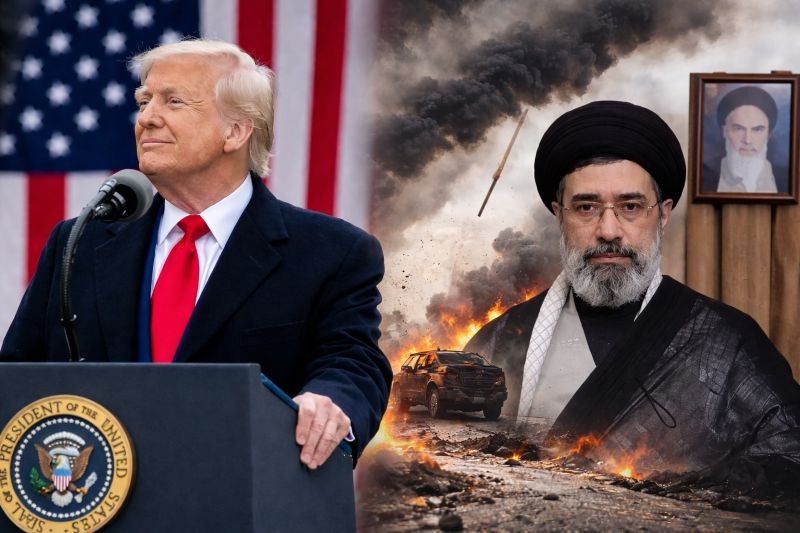
The US Central Command (CENTCOM) said the strikes marked the eighth consecutive night of operations against Iranian targets and were intended to "swiftly punish" forces linked to Iran's Islamic Revolutionary Guard Corps (IRGC), which Washington blames for attacks on American personnel in the region.
CENTCOM Statement on Recently Fallen, Missing U.S. Service Members
— U.S. Central Command (@CENTCOM) July 18, 2026
TAMPA, Fla. — On July 17, two U.S. service members in Jordan were killed in action as U.S. Central Command (CENTCOM) and partner forces defended against Iranian ballistic missile and drone attacks. Additionally,…
President Donald Trump ordered the strikes, which CENTCOM said were designed to further reduce Iran's ability to threaten commercial shipping in the Strait of Hormuz, a key global energy corridor.
Two US soldiers killed in Jordan attack
Hours before announcing the latest strikes, CENTCOM confirmed that two US service members were killed while defending against Iranian ballistic missile and drone attacks in Jordan on Friday. Another American soldier remains missing.
The military said four personnel were medically evacuated to hospitals in Jordan and have since been discharged, while others treated for minor injuries have returned to duty.
The latest fatalities bring the total number of confirmed US military deaths since the conflict erupted on February 28 to 16.
Iran claims strike on US base
Iranian state media reported that fuel storage facilities at the Al-Azraq US base in Jordan were targeted during recent operations.
A day earlier, Iran's Revolutionary Guards had announced missile and drone attacks on US aircraft and military assets stationed in Jordan, describing them as retaliation for continued American military action.
Conflict reignites after collapse of peace deal
The latest escalation comes weeks after a preliminary agreement between Washington and Tehran collapsed.
US and Iranian leaders had signed a 14-point framework on June 17 aimed at halting hostilities and paving the way for a broader peace settlement within 60 days.
The deal included an immediate cessation of military operations across multiple fronts.
However, President Trump declared the agreement "over" on July 8, while Tehran later suspended the memorandum, accusing Washington of violating its commitments.
Since then, hostilities have intensified, with the US accusing Iran of threatening commercial vessels in the Strait of Hormuz and Tehran responding with attacks on American military facilities across the Gulf region.
Iran's Supreme Leader issues warning
Iran's Supreme Leader Mojtaba Khamenei, who succeeded his father Ali Khamenei following his death in the February 28 strikes, sharply criticised Washington over the breakdown of the agreement.
In a post on X, Khamenei said the repeated violations of the deal had exposed what he described as the "worthlessness" of the US president's commitments.
The Great Satan – the criminal US – has now realized that the continuation of its trouble-free, domineering presence in the region is nothing but a naive fantacy.
— Ayatollah Mojtaba Khamenei (@MKhamenei_ir) July 18, 2026
He warned that Iran and its allied resistance groups were preparing an "unforgettable" response if the United States continued expanding military operations.
Tehran threatens wider offensive
Adding to the warning, senior military adviser Major General Mohsen Rezaei said Iran could significantly intensify its military campaign if US strikes continue.
According to Iranian state media, Rezaei said Tehran would no longer restrict itself to proportional retaliation and could resume "full-scale offensive operations" in response to further American attacks.
Middle East on edge as hostilities deepen
With both sides exchanging increasingly severe threats and military strikes, fears are mounting of a wider regional conflict.
The collapse of diplomatic efforts and the growing death toll have raised concerns that the confrontation could spiral into a prolonged and more dangerous phase in the weeks ahead.