
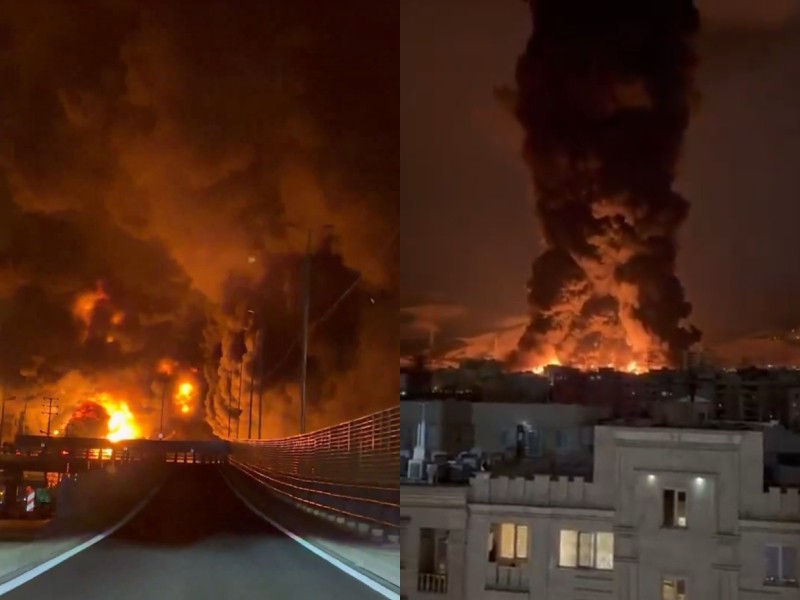
According to a report by Axios, officials in Washington reacted with surprise and frustration after Israeli forces targeted multiple oil depots and a refinery near the Iranian capital, Tehran.
While Israeli authorities had informed the US in advance, American officials reportedly believed the strikes were far more extensive than anticipated.
📍#Iran
— ARIKA🇮🇳🚩 (@nidhisj2001) March 8, 2026
Oil as been flooded to all the pipeline streams including sewages resulting fire across the city ❗️❗️#IranIsraelWar #IranWar pic.twitter.com/4d3m7gyhad
One US official told Axios that the scope of the attack surprised the American military and suggested it might not have been a wise strategic move.
An Israeli official reportedly described Washington’s reaction in blunt terms, saying the message from the White House was essentially “WTF”.
Neither the White House nor the Israel Defence Forces (IDF) had issued official comments on the report at the time.
Massive fires and destruction near Tehran
Israeli strikes reportedly targeted three oil depots and a refinery located in and around Tehran, triggering massive explosions and fires that spread rapidly across the affected areas.
Visuals from the scene showed towering flames and thick black clouds of smoke rising over the capital, creating scenes described by observers as apocalyptic.
Fuel leaking from damaged storage tanks caught fire, and residents reported that burning oil flowed through nearby streets like a “river of fire”.
Following the attacks, rainfall in some areas reportedly turned dark due to oil residue and soot.
🇮🇱🇺🇸🇮🇷⚡️WATCH: A pipeling exploding on Shahran Boulevard in Tehran after oil infrastrure was hit by US and Israel.
— The Battlefield (@TTheBattlefield) March 8, 2026
See the latest updates with us:@TTheBattlefield pic.twitter.com/tIUlD70sqV
Authorities warned people to remain indoors amid concerns over toxic smoke and reports of potentially hazardous rainfall caused by the fires.
The strikes reportedly resulted in at least four fatalities, though the full extent of the damage remains unclear.
Escalation raises strategic and environmental concerns
Military analysts say the attack signals a serious escalation in the ongoing war.
Beyond the immediate destruction, the strikes carry significant humanitarian and environmental risks.
Fires involving large quantities of oil products can release toxic pollutants into the atmosphere and contaminate surrounding areas.
Tehran is a war zone.
— Evan Kilgore 🇺🇸 (@EvanAKilgore) March 8, 2026
The United has just struck Iran's oil deports.
This looks like a scene from an apocalyptic movie.
Donald Trump has completely betrayed his MAGA base to appease Israel.
I will not be voting in the Midterms.
I'm out. pic.twitter.com/REu8IaiHrM
However, analysts say the broader implications of the attack extend far beyond environmental damage.
By targeting oil infrastructure, the strikes have introduced new risks to global energy markets and could reshape the strategic dynamics of the conflict.
Oil prices jump above $100
The economic impact of the attack was felt almost immediately in global energy markets.
Oil prices surged sharply after trading resumed, reflecting growing concerns about supply disruptions linked to the conflict and the ongoing blockade of the Strait of Hormuz, one of the world’s most critical energy shipping routes.
A barrel of Brent crude rose to around $107.97, marking a jump of more than 16 percent from its previous closing price of $92.69.
The benchmark had already been under pressure due to regional tensions.
Meanwhile, West Texas Intermediate crude climbed to approximately $106.22 per barrel, reflecting a similar increase of nearly 17 percent.
The surge pushed oil prices above the $100-per-barrel threshold for the first time in nearly four years, raising fears of further economic turbulence if the conflict continues to intensify.
Washington worried about strategic fallout
Reports suggest the US administration is concerned that targeting Iranian oil infrastructure could prove counterproductive.
American officials fear that such attacks might strengthen domestic support for the Iranian government by rallying citizens against external pressure.
The potential economic fallout also remains a key concern. Rising oil prices could fuel global inflation and increase fuel costs for consumers.
A senior adviser to US President Donald Trump told Axios that the president was unhappy with the strike.
“The president doesn’t like the attack. He wants to save the oil. He doesn’t want to burn it,” the adviser reportedly said, adding that higher fuel prices remain a major concern.
Iran warns of retaliation
Iranian officials have reacted angrily to the attack and warned that further strikes on oil facilities could trigger retaliatory actions.
A spokesperson for Iran’s military said Tehran had so far avoided targeting energy infrastructure but suggested that policy could change if Israeli attacks continue.
Iran has also warned that escalation could drive oil prices dramatically higher, with some officials suggesting global crude prices could potentially rise to $200 per barrel if the conflict spreads further.
With the war already disrupting shipping lanes and global energy markets, analysts say any expansion of attacks on oil infrastructure could have far-reaching consequences for both regional stability and the global economy.