
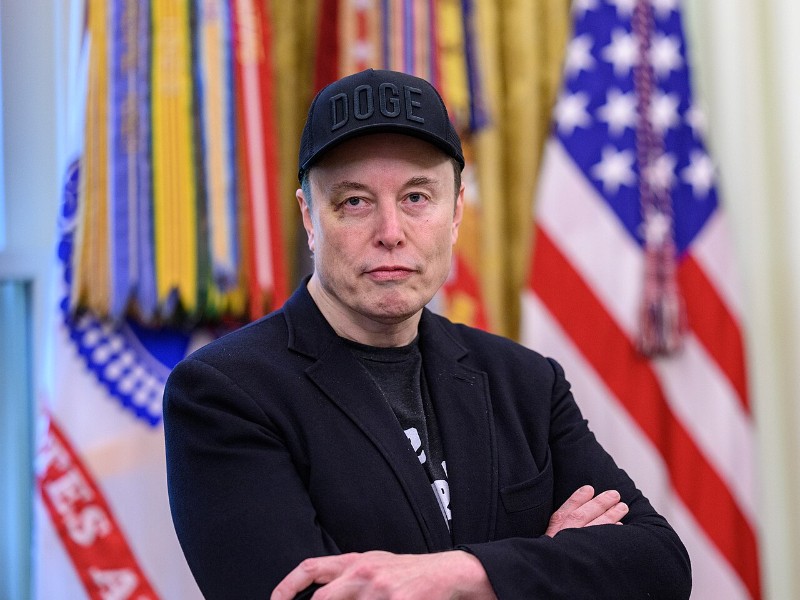
Musk, the chief executive of Tesla and SpaceX, was the biggest individual donor during the election campaign, directing much of his financial support towards candidates from President Donald Trump's Republican Party, particularly in Texas, where several of his companies have major operations.
Speaking virtually at the New York Times DealBook Summit on Wednesday, Musk also distanced himself from the president's Make America Great Again (MAGA) movement, declaring: “I'm not MAGA.”
His remarks marked a notable shift from his earlier public association with the movement, which he had openly embraced during Trump's 2024 presidential campaign.
Musk questions his Republican campaign spending
Reflecting on the substantial amount he contributed to Republican candidates, Musk said he had little to show for the money spent following the party's poor electoral performance.
“I'm not sure what MAGA means... if that means sort of blind adherence to a set of policies by the Republican Party, then I certainly don't have that,” he said.
Musk acknowledged that his record campaign expenditure had not produced the expected results, although he suggested that Republican candidates might have performed even worse without his financial backing.
His comments followed an election in which Democrats secured control of both chambers of the US Congress, overturning Republican-held seats and making significant gains in areas that had supported the party for decades.
The results represented a major setback for Trump, whose administration has faced mounting criticism over the impact of its policies on the cost of living in the United States.
From MAGA supporter to political distance
Musk's declaration that he was not part of the MAGA movement contrasts sharply with his earlier public statements in support of Trump.
At a Republican campaign rally in 2024, the billionaire had joked about his political identity, saying: “I'm not just MAGA, I'm dark, gothic MAGA.”
He also played a prominent role during the early months of Trump's second presidential term.
For several months, Musk served as an unpaid special government employee and senior adviser to the president.
He led the Department of Government Efficiency (DOGE), which was tasked with identifying ways to reduce federal expenditure.
In October 2026, the Pentagon named Musk as a co-lead of Project Meridian, a proposed study examining the future of warfare.
He continued to travel with Trump and advise the president.
Republican losses could affect Musk's businesses
The Democrats' gains in Congress could have wider implications for Musk's business interests, particularly as the party has promised closer scrutiny of major technology companies and their expanding infrastructure projects.
Democratic lawmakers have raised concerns about the construction of large data centres and the tax incentives offered to technology companies to establish such facilities.
In Georgia, where SpaceX operates data centre facilities, the newly elected Democratic governor pledged to restrict the expansion of large data centres and review the tax breaks granted to technology companies.
Democratic lawmakers have also called for scrutiny of SpaceX, which has secured an estimated $10 billion in additional government contracts since Trump's re-election.
The potential shift in congressional oversight could therefore bring greater attention to Musk's companies and their dealings with the federal government.
Musk spent 'at least $45 million' on Texas race
One of the most significant Democratic victories came in Texas, where James Talarico defeated Republican Ken Paxton in the race for a US Senate seat.
According to BBC analysis, Musk had spent at least $45 million supporting Paxton's campaign.
Texas holds particular importance for Musk, as it hosts major operations of Tesla, his electric vehicle company, and SpaceX, his rocket and technology business.
The billionaire also commented on the state's political shift after Democrat Gina Hinojosa defeated Republican Governor Greg Abbott, ending more than three decades of Republican control.
Musk said he expected Hinojosa to govern from a moderate position.
“I don't think she's a far-left governor. And based on everything I've heard about her, I think things will be fine in Texas with Gina as governor,” he said.
Hinojosa's victory, alongside the broader Democratic gains in the midterm elections, marked a significant political change in a state that has long been a Republican stronghold.