
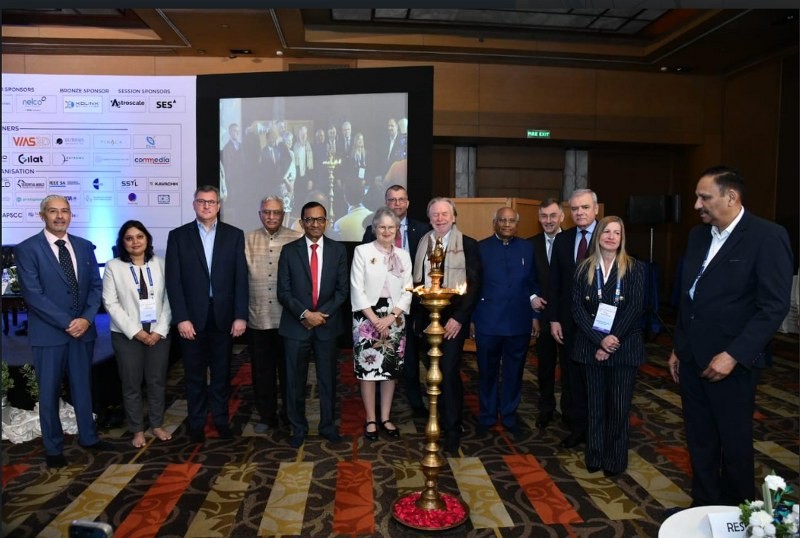
The opening coincided with a historic milestone—Group Captain Shubhanshu Shukla of the Indian Air Force lifted off aboard the Axiom-4 mission, becoming the second Indian in space.
The livestream of the launch was witnessed by delegates at the Congress, further highlighting the significance of India’s participation in international crewed missions.
Hungary, this year’s Country Partner at ISC, also had a national aboard the same flight.
“This moment signals India’s ascent in global space innovation,” said Subba Rao Pavuluri, President, SIA-India, the organiser of the event.
The inauguration was marked by the presence of dignitaries, including Dr Thierry E. Klein (Nokia Bell Labs), Dr Shailesh Nayak (NIAS), Dr Pawan K. Goenka (IN-SPACe), and diplomats from Australia, including Her Excellency Frances Adamson, Governor of South Australia, and High Commissioner Philip Green.
One of the key outcomes was the signing of a Memorandum of Understanding between SIA-India and the International Institute of Space Law (IISL), reinforcing India’s commitment to responsible and cooperative space governance.
"Over the next three days, ISC 2025 will explore frontier technologies like quantum computing, microgravity manufacturing, and AI while also deep-diving into areas such as satellite communications, Earth observation, and navigation systems like NavIC,” said Anil Prakash, DG, SIA-India.
In his keynote address, Dr Shailesh Nayak urged SIA-India to define technical specifications that can guide private investment in Earth observation, particularly as demand grows from agencies like the Defence Space Agency.
He stressed the need to identify ISRO-developed technologies suitable for transfer to private industry.
Dr Pawan Goenka, Chairman of IN-SPACe, said a reliable framework for valuing India’s space economy is in the works. “We are collaborating with MoSPI, academia, and industry to build a transparent system. Measuring the economic value of the space sector is long overdue,” he added.
Australia’s growing space collaboration with India also took centre stage, with South Australian Governor Frances Adamson noting that both countries were natural partners in the sector.
The day also saw the release of the PRISM 2.0 report, which offers recommendations to ease regulations, harmonise export controls, and boost trade and innovation between the two nations.
With 35 sessions planned over three days, ISC 2025 is expected to offer critical insight and direction to India’s evolving space sector—one increasingly driven by public-private collaboration and global partnerships.