
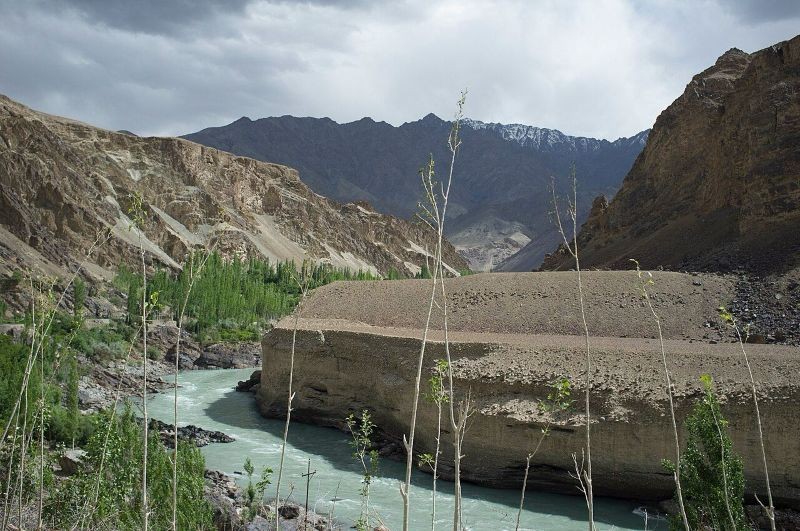
Built entirely using natural boulders and without cement, the project is aimed at improving irrigation for farmers who have long struggled to access sufficient water during the crucial spring sowing season.
40 million litres of water stored
The newly constructed check dam can store nearly 40 million litres of water. The accumulated water is being channelled into dry agricultural fields through the Igoo Phey irrigation canal, providing much-needed support to farming communities in the region.
For years, farmers faced difficulties in drawing water from the Indus as the river flowed at a low level through deep gorges.
The situation made conventional pumping difficult, particularly during the spring sowing season.
Water scarcity had severely affected agricultural activity and placed an economic burden on local farming families.
Boost to irrigation in border areas
Apart from addressing the region's water shortage, the project is significant from a strategic perspective.
With India having placed the Indus Waters Treaty in abeyance, the infrastructure reflects a greater focus on utilising Indus River water for communities and agriculture in India's border regions.
The project is expected to strengthen local water security while expanding irrigation potential in areas that have historically faced severe shortages.
36 more check dams proposed
The Ladakh administration is now planning several additional check dams along the Indus and other river systems.
A proposal submitted to the Union Ministry of Jal Shakti seeks approval for 36 check dam projects across the Union Territory.
The proposal includes seven Himalayan Rock Check Dams in the Leh region and 29 reinforced cement concrete (RCC) check dams or weirs in Kargil, with the total estimated cost exceeding Rs 56 crore.
Work has already begun at some locations, while several other projects are in the pipeline.
Focus on water security
The Upshi project is being viewed as an important step towards strengthening irrigation infrastructure in the high-altitude Union Territory, where agriculture is heavily dependent on limited water resources.
The expansion of check dams is expected to help conserve river water, improve irrigation access and support farming communities while also increasing India's utilisation of water resources in strategically important border areas.