
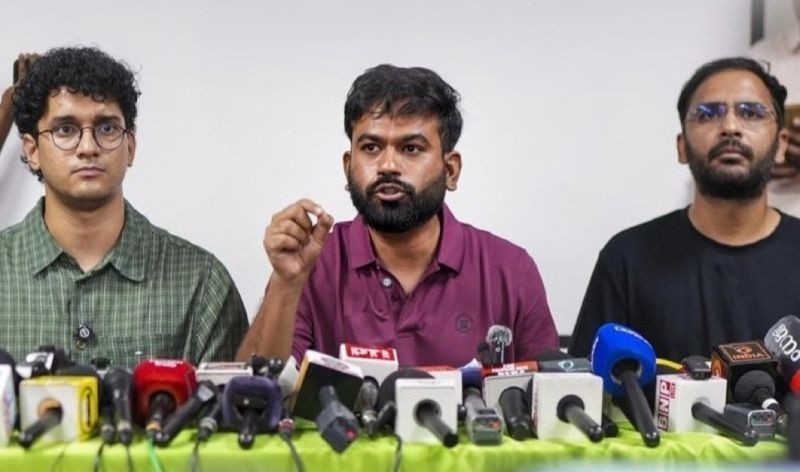
The three were taken to the executive magistrate’s court in Delhi Cantonment on Sunday morning.
FINALLY DELHI POLICE IS FORCED TO RELEASE ABHIJEET DIPKE, ASHUTOSH RANKA AND SAURAV DAS. Cockroaches never die 🪳
— Cockroach Janta Party - CJP (@Cockroachisback) October 11, 2026
They had been detained on Saturday after their flight landed in Delhi and were subsequently placed under preventive arrest.
According to NDTV, the court released them on the condition that they would not engage in any activity considered a “breach of peace” for one year.
Over 3,000 detained during Delhi protest
The arrests came on the second day of the planned CJP protest demanding action over alleged irregularities in the Special Intensive Revision (SIR) of electoral rolls.
More than 3,000 protesters, including politicians, were detained on Saturday and released later that night.
Police imposed extensive security restrictions across the national capital to prevent demonstrators from gathering at Jantar Mantar.
The restrictions forced protesters to split into smaller groups and assemble at different locations across Delhi.
YouTube activist Dhruv Rathee was among those released late on Saturday night. Rathee is known for his criticism of the NDA government and has expressed support for Congress leader Rahul Gandhi.
Supreme Court hearing expected over metro shutdown
A key development expected on Sunday is a special sitting of the Supreme Court to hear a contempt petition concerning the blanket closure of Delhi Metro stations and the suspension of train services on Saturday.
Metro services were running on Sunday morning, although security remained tight at station entrances and exits. Buses were also stationed nearby to transport detained protesters.
On Friday, a bench comprising Chief Justice of India Surya Kant and Justices Joymalya Bagchi and V. Mohan had directed that metro services should not be completely stopped ahead of the planned demonstration.
CJP vows to continue protest over voter roll allegations
CJP leaders have said their street protests would continue until accountability is established over what they allege to be the deletion and manipulation of 13 crore votes.
The group has accused authorities of imposing an “undeclared emergency” in the national capital to prevent people from exercising their right to peaceful assembly.
The allegations of voter roll manipulation remain contested.
Dipke, a Boston University graduate, founded the CJP and returned to India to lead protests over the NEET examination paper leak controversy, which triggered demands for action against Union Education Minister Dharmendra Pradhan.
The group has received support from Opposition parties across the country.
BJP accuses CJP of acting against national interests
The Bharatiya Janata Party (BJP) has described the CJP as an extension of Opposition forces seeking to destabilise the country.
BJP president Nitin Nabin has alleged that Opposition groups were attempting to harm India while acting at the direction of “foreign forces”.
Defence Minister Rajnath Singh, meanwhile, said every individual had the right to express dissent in a democracy but cautioned against activities that could lead to anarchy.
He said members of Gen Z might be “momentarily misled” but could not be diverted from the goal of nation-building.