
It was a multifaceted programme that targeted almost every sphere of society, from the judiciary, media and school system to the bureaucracy and business community.
Government-backed mobs forced many individuals — from the Chief Justice to ordinary school teachers — to resign.
Fake criminal charges were levelled against tens of thousands of people, including journalists, professors and judges. The Yunus administration launched a sweeping crackdown to arrest them.
Even doctors were not spared. Bangladesh’s fragile medical system nearly collapsed as many specialist physicians either fled for safety or landed in gaol.
The atmosphere resembled the madness once unleashed by Joseph Vissarionovich Stalin in the Soviet Union. Stalin had sent doctors to the Gulag and, when he himself fell gravely ill, there were too few competent doctors left in Moscow to treat him properly.
History, in some ways, has repeated itself in Bangladesh, now ruled by the Tarique Rahman-led government of the Bangladesh Nationalist Party (BNP).
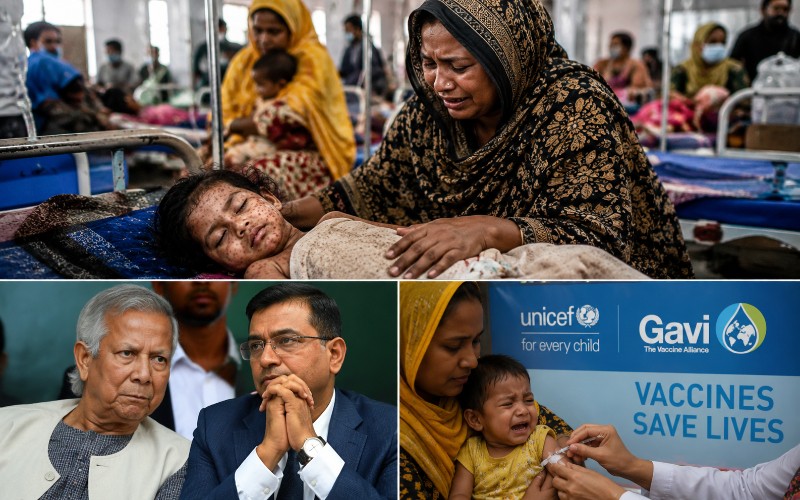
Nearly 450 children have already died in an unprecedented measles outbreak.
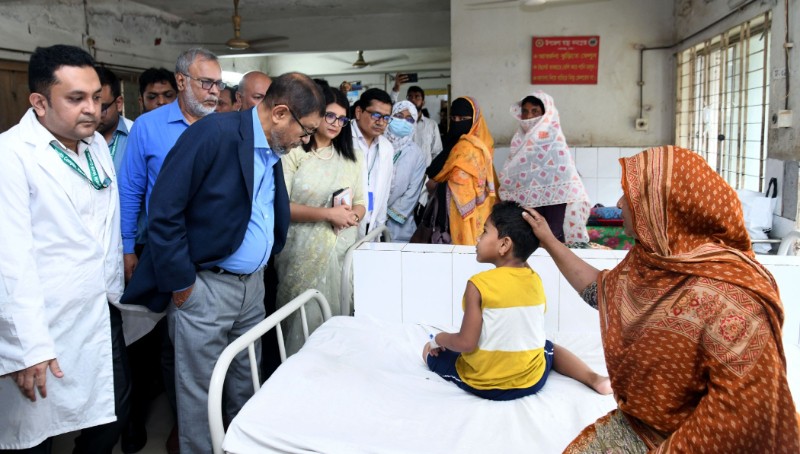 Bangladesh Health Minister inspecting vaccination center at Baddhanpara Government Primary School, Dhaka, during Emergency Measles Rubella Vaccination Programme. Photo: Wikimedia Commons/PID Bangladesh
According to a May 20 report in The Telegraph, “more than 55,000 infections have been recorded since mid-March”.
Most of the victims are children under the age of 10, with the highest concentration among those under five. The reasons behind the outbreak have been widely reported: an immunisation gap created during the Yunus administration.
The Nobel Peace Prize-winning interim head appeared driven by a burning ambition to disprove Sheikh Hasina and humiliate her legacy in every possible sphere.
That became his way of projecting greatness. Corruption has long been a recurring theme in Bangladeshi politics, and the Hasina era was no exception. Yet Yunus crossed all limits of imagination in his allegations.
Hasina was accused of stealing $5 billion from a $12 billion Russian-built nuclear power project.
However, even a simple internet search shows that nuclear plants of similar configuration and technology cost roughly the same across the world.
It was this misplaced ambition and destructive politics that reportedly led Yunus to deviate from established procedures for vaccine procurement through the United Nations Children’s Fund (UNICEF) and the Gavi vaccine alliance.
UNICEF Representative to Bangladesh, Rana Flowers, reportedly stated in The Daily Star on May 20, 2026, that her office held at least 10 meetings with health officials and sent half a dozen letters to the Yunus administration between 2024 and 2025, warning about the possible consequences of disruption in immunisation coverage.
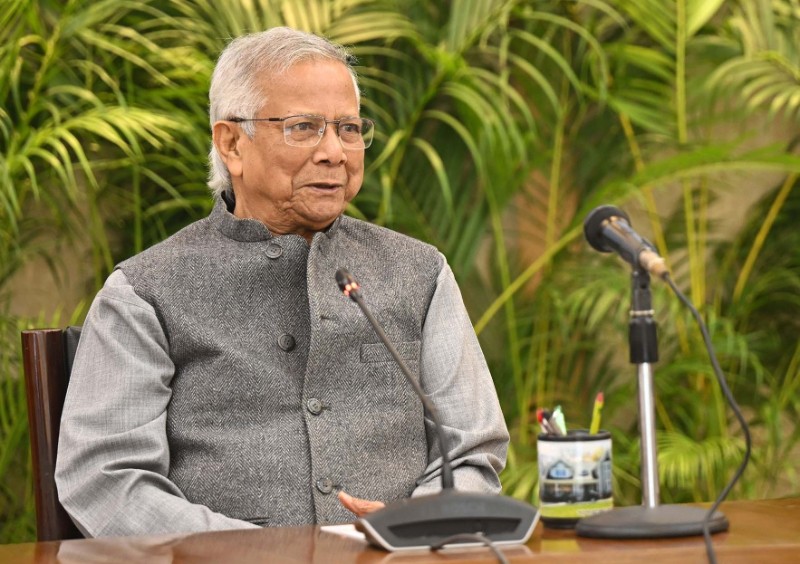 Muhammad Yunus. Photo: Wikimedia Commons/PID Bangladesh
Yunus, however, remained unmoved. Today, hundreds of Bangladeshi parents are paying the price.
That perhaps marks the biggest difference between Bangladesh and Stalin’s Russia. Stalin ultimately paid with his life for his paranoia and excesses.
In Bangladesh, however, the Tarique Rahman government remains influenced by the same Islamist forces that dictated terms to Yunus during the interim phase.
Those Islamist groups, in turn, maintain deep ideological and political connections with Pakistan, where the value attached to human life has often appeared disturbingly low in matters of governance and public health.
The contrast becomes sharper when one examines health indicators. In 2023, while Sheikh Hasina was still in power, Bangladesh recorded a child mortality rate of 24.4 per 1,000 live births.
In Pakistan, the ratio was more than double. Bangladesh, despite its limitations, had managed to build a reputation for delivering comparatively effective public health outcomes through immunisation drives and rural healthcare initiatives. That progress now appears seriously undermined.
The net result is that Prime Minister Tarique Rahman has remained conspicuously silent on the disastrous role played by the Yunus administration in the deadly measles outbreak and the deaths of hundreds of children.
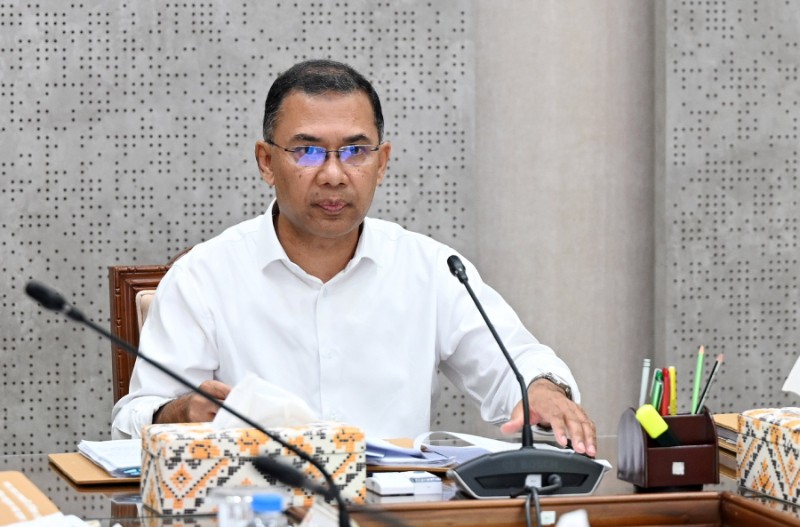 Bangladesh PM Tarique Rahman. Photo: Wikimedia Commons/PID Bangladesh
Much of Dhaka’s heavily censored media has also failed to uphold public accountability. One bereaved father, after losing his daughter, reportedly told journalists: “You cannot bring justice.” His words captured the despair felt by countless families.
Only a handful of fiercely independent commentators have continued to speak out. Some have openly labelled Yunus a “mass murderer” on social media platforms.
Yet sparing Yunus may not ultimately help Tarique Rahman’s own political cause either. Former BNP activist and independent Member of Parliament Rumeen Farhana has questioned the role of the Tarique Rahman government in the child deaths.
Farhana pointed out that many fatalities occurred because emergency facilities, including oxygen supply and ambulance services, were either unavailable or grossly inadequate.
She accused the BNP government of patronising a VIP culture while neglecting the needs of ordinary citizens. Farhana has also stated bluntly that governance in Bangladesh has deteriorated since the departure of Sheikh Hasina from power.