
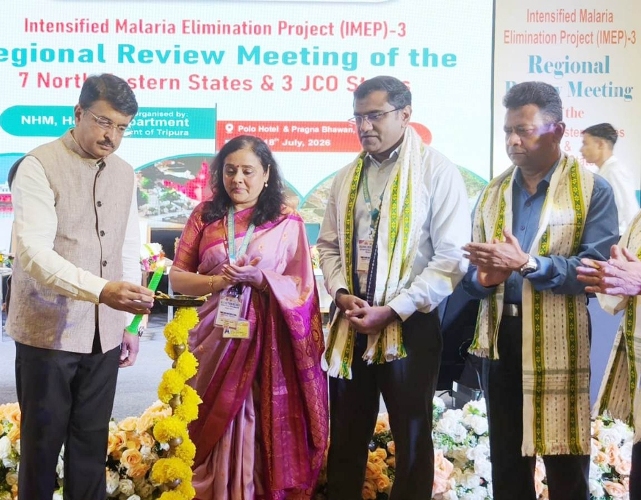
A three-day regional review meeting on the Intensified Malaria Elimination Project (IMEP)-III commenced in Agartala on Thursday, bringing together health officials, public health experts and development partners from 10 states to review progress and strengthen strategies for achieving India's goal of malaria elimination by 2027.
The meeting is being jointly organized by the Tripura Health and Family Welfare Department and the National Centre for Vector Borne Disease Control (NCVBDC) under the Union Ministry of Health and Family Welfare. The inaugural session was held at a city hotel, while the remaining sessions on July 17 and 18 will take place at Pragya Bhavan.
Tripura Health Secretary Kiran Gitte inaugurated the programme in the presence of NCVBDC Director Dr. Tanu Jain as the guest of honour.
Addressing the gathering, Gitte said malaria elimination remains one of the top public health priorities of both the Central and Tripura governments. He noted that the state's malaria burden has declined significantly due to regular surveillance, early diagnosis, prompt treatment, public awareness campaigns and coordinated efforts among various departments. He stressed the importance of early detection of every malaria case, immediate response to infections and intensified community participation to prevent resurgence and sustain progress towards elimination.
Dr. Jain said the Intensified Malaria Elimination Project-III is playing a crucial role in helping the country achieve its target of becoming malaria-free by 2027. He appreciated the collective efforts of participating states and emphasized the need for case-based surveillance, data-driven decision-making, accurate diagnosis, strengthened vector control measures, improved health system capacity and enhanced inter-state and cross-border coordination, particularly in malaria-prone and border areas.
The review meeting is being attended by programme officers, public health specialists and representatives of development partner organizations from the seven Northeastern states, along with Jharkhand, Chhattisgarh and Odisha. The participants will assess the implementation status of IMEP-III, discuss challenges and formulate future strategies to accelerate malaria elimination efforts.
The three-day deliberations will focus on reviewing the project's achievements, analyzing district-wise malaria trends, identifying implementation gaps, strengthening surveillance, diagnosis, treatment and vector control systems, enhancing inter-state technical collaboration, and preparing a roadmap to achieve a malaria-free India by 2027.
Organizers expressed confidence that the regional review meeting would provide valuable technical guidance and practical recommendations to further strengthen malaria elimination programmes in the Northeast as well as Jharkhand, Chhattisgarh and Odisha, thereby contributing significantly to the national malaria elimination mission.