
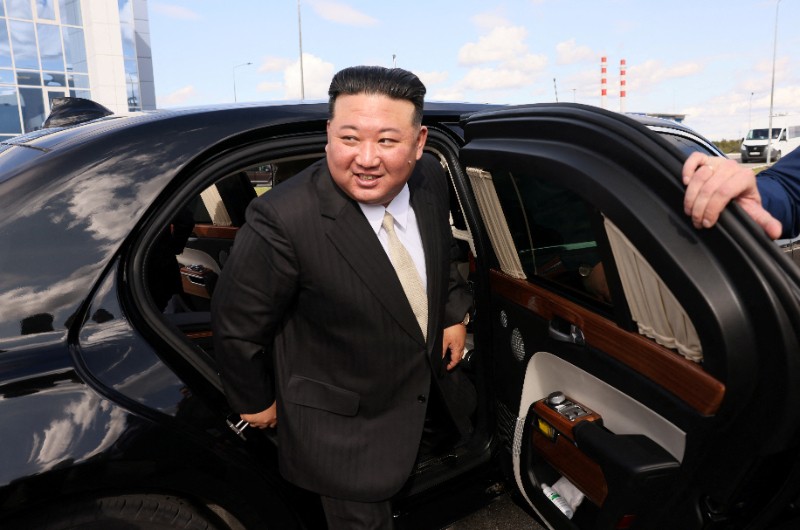
The vote, held on March 15 to elect representatives to the country’s legislature, resulted in a complete sweep for candidates backed by the Workers' Party of Korea and its affiliated groups.
According to the state-run Korean Central News Agency, every single seat in the 15th Supreme People’s Assembly was won by government-approved candidates.
Turnout figures raise eyebrows
Official figures released by state media presented an almost unanimous endorsement of the leadership.
Authorities claimed voter turnout reached an extraordinary 99.99 percent, with nearly all ballots cast in favour of the ruling establishment.
A tiny fraction of registered voters, approximately 0.0037 percent, were reportedly unable to vote due to being overseas or at sea.
Meanwhile, an even smaller share, around 0.00003 percent, allegedly abstained.
These figures reinforce North Korea’s long-standing pattern of near-perfect electoral participation and approval, often viewed by outside observers as tightly controlled.
Mystery of 0.07% ‘no votes’
Despite the overwhelming result, the election has drawn attention for an unusual detail — 0.07 percent of voters rejected the official candidates.
There were no opposition figures on the ballot. Each constituency presented voters with a single, pre-approved candidate, leaving them with a binary choice — endorse or reject.
This means the small percentage did not represent support for an alternative party, but rather individuals who voted “no” against the sole candidate.
Notably, this is the first time in decades that North Korean state media has publicly acknowledged the existence of dissenting votes in a parliamentary election, a disclosure not seen since 1957.
How North Korea’s electoral system works
Under North Korean law, the Supreme People’s Assembly consists of 687 representatives drawn from various sectors, including workers, farmers, military personnel and officials.
However, the structure of the electoral system ensures that each district has only one candidate, pre-selected by the ruling leadership.
Voters are therefore not choosing between competing candidates but are instead confirming or rejecting the state’s nominee.
This system effectively guarantees that all elected representatives align with the leadership under Kim Jong Un.
Consolidation of power since 2011
Kim Jong Un assumed power in 2011 following the death of his father, Kim Jong Il.
Since then, he has steadily consolidated authority across all branches of the state.
In 2019, constitutional changes further strengthened his position, formally designating him as head of state and reinforcing what officials describe as a “monolithic” leadership structure.
The latest election results reaffirm his continued dominance over North Korea’s political system, even as the rare acknowledgement of “no votes” introduces a small but notable deviation from past narratives.