
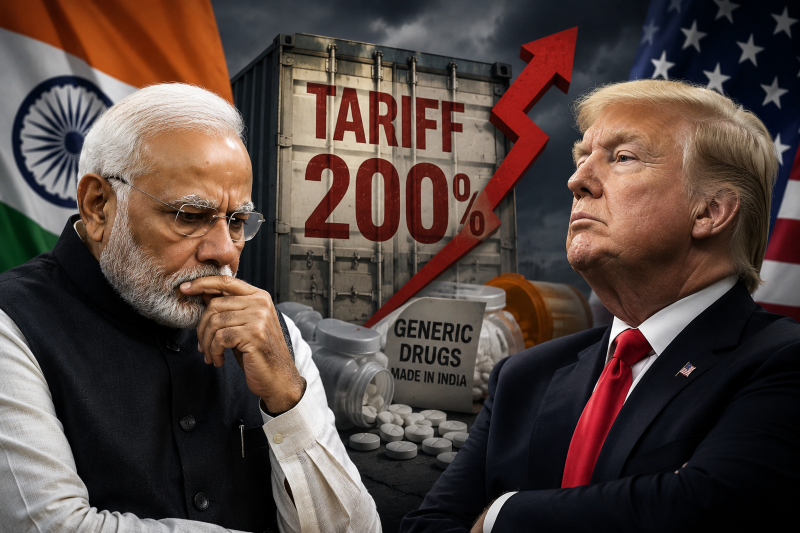
In a post on Truth Social, the President wrote, "Effective August 1st, 2026, all Generic Drugs being brought into the United States will continue to have a TARIFF of ZERO PERCENT for a two year period of time, after which the TARIFF will be raised to 100% for a one year period of time, and 200% thereafter."
The two-year window has been provided to allow pharmaceutical companies to shift their production to the United States before the steep tariffs take effect.
The move is aimed at encouraging pharmaceutical companies to manufacture generic medicines within the United States.
Impact on India
Pharmaceutical exports could take a major hit: The United States is India's largest pharmaceutical export market, and India supplies a substantial share of the generic medicines consumed there. A 200 percent tariff would significantly increase the cost of Indian generic drugs, reducing their competitiveness in the US market.
Revenue loss for Indian drugmakers: Major Indian pharmaceutical companies such as Sun Pharma, Dr. Reddy's Laboratories, Cipla, Lupin, Aurobindo Pharma, Zydus Lifesciences, Glenmark and Torrent Pharma could witness a decline in US revenues and shrinking profit margins owing to reduced demand.
Pressure on manufacturing and jobs: Companies that are heavily dependent on the US market may be forced to scale back production. This could also affect employment in pharmaceutical manufacturing, packaging, logistics and other allied sectors.
Diversification to other markets: To offset the impact, Indian pharmaceutical companies may accelerate their expansion into alternative markets, including:
- Europe
- Latin America
- Africa
- Southeast Asia
- The domestic market
However, replacing the US market would be a difficult task in the short term due to its scale and profitability.