
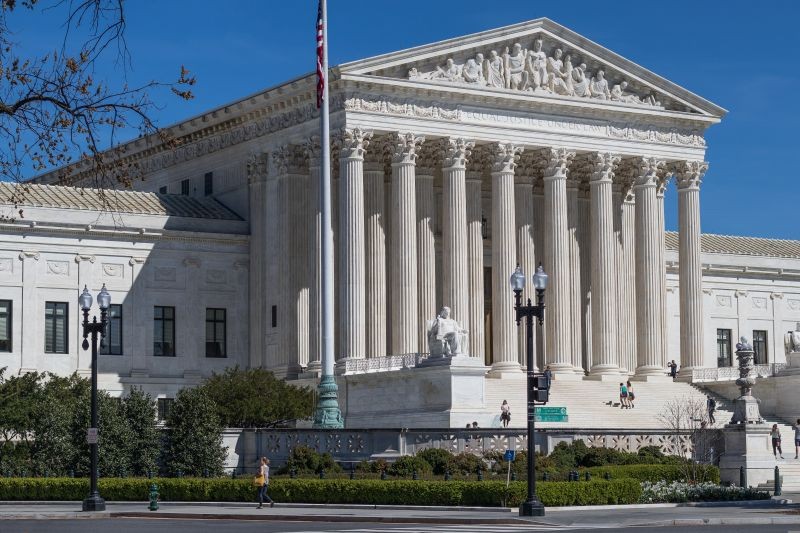
The ruling allows Idaho, West Virginia and more than two dozen other Republican-led states to enforce laws requiring students in public schools and colleges to compete on sports teams based on their sex assigned at birth rather than their gender identity.
The decision is the latest indication of the conservative-majority court's willingness to side with states on transgender rights.
It follows last year's ruling upholding Tennessee's ban on gender-affirming medical care for minors.
Challenge to state laws
The cases before the Supreme Court were brought by transgender students who argued that the state laws violated the US Constitution's Equal Protection Clause as well as Title IX, the federal civil rights law that prohibits sex-based discrimination in education.
Supporters of the restrictions argued that the measures are necessary to ensure fair competition and protect athletic opportunities for girls and women.
Opponents countered that the laws unfairly target a small and vulnerable group of students, excluding them from school sports and turning children's athletics into a politically charged issue.
The Idaho case
The Idaho dispute stemmed from the state's 2020 Fairness in Women's Sports Act, which was challenged by a transgender athlete attending an Idaho university. Lower courts had earlier ruled the law unconstitutional.
During arguments before the Supreme Court in January, Idaho Solicitor General Alan Hurst defended the law, arguing that "sex is what matters in sports" because of biological differences such as size, strength, muscle mass and lung capacity.
The West Virginia case
The West Virginia case involved a teenage transgender girl who was barred under a 2021 state law from competing on her middle school's girls' track team.
Her lawyers argued that transgender girls who undergo testosterone-suppressing treatment do not retain an unfair athletic advantage.
They contended that the laws amount to broad exclusions driven more by politics than scientific evidence.
A significant legal victory
The ruling marks another significant legal victory for Republican-led states seeking to restrict transgender rights and is expected to reinforce similar laws already enacted across much of the United States.
The decision also signals the Supreme Court's continued support for allowing states broad authority to regulate participation in school sports based on biological sex.