
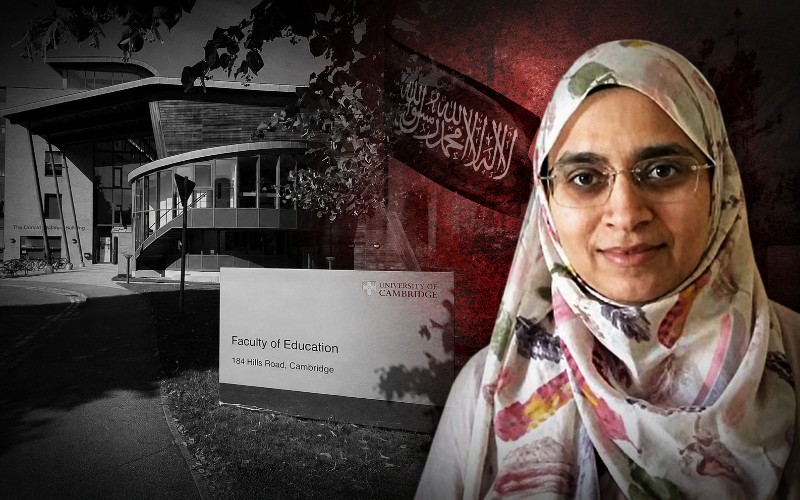
The writings have been highlighted by The Spectator in an investigation by Andrew Gilligan, which examines Ahmed’s former involvement with Hizb ut Tahrir and her current role at Cambridge.
According to The Spectator, Ahmed co-wrote a chapter in a Hizb ut Tahrir pamphlet arguing that higher education should be used to strengthen an Islamic society and advance its stated religious and political objectives.
Ahmed was previously an activist with Hizb ut Tahrir, an Islamist organisation that is proscribed as a terrorist organisation in the UK.
The allegations and past writings form the latest instalment in The Spectator’s reporting on Ahmed, who now holds a senior academic role involving the training and education of future teachers.
Writings on engineering and ‘advanced weaponry’
The chapter, written by Ahmed and senior Hizb ut Tahrir activist Nazreen Nawaz, outlined the organisation’s vision for an education system operating under the Khilafah, or Islamic state.
The authors argued that education should be structured around Islamic principles and should exclude ideas they regarded as incompatible with Islam.
The chapter stated that "nothing will be contained within the curriculum that contradicts with Islam", including the teaching of freedom, nationalism, democracy or evolution "in a positive light".
It also argued that non-Muslims should be educated within an Islamic curriculum.
"Nor can there be any schools established on any other religion, sect or race… Even the non-Muslims need to be educated under the educational curriculum of Islam… by pushing them to think about the correct belief in life," the chapter said.
The authors also addressed the purpose of university education, arguing that subjects including foreign philosophies, religions, capitalism, communism, socialism, nationalism, sociology, psychology, foreign history, foreign languages and foreign literature should be taught at higher levels primarily to challenge or reject their ideas.
The section on engineering and computer technology went further.
"The motivation to study engineering would be to aid the development of machinery for Jihad," the authors wrote.
They added that studying computer technology would help elevate Islamic society and "produce advanced weaponry for Jihad", with the stated objective of enabling Islam to dominate other religions.
Focus on Islamic education, teacher training
The pamphlet also included a section dealing specifically with the training of teachers.
According to The Spectator, the section is particularly relevant to Ahmed’s present position because her work at Cambridge involves education and the training of future teachers.
The pamphlet was originally published in 2002 and republished in 2017. The Spectator reported that Ahmed was not involved in its republication.
In an earlier report, The Spectator examined another chapter written by Ahmed in the same pamphlet.
That chapter criticised what it described as "western education", opposed democracy and integration, and objected to British schools teaching pupils that child marriage was wrong.
The latest report focuses on the second chapter, which sets out a broader vision for education under Hizb ut Tahrir’s proposed Khilafah.
Ahmed previously distanced herself from Hizb ut Tahrir views
Ahmed said in 2010 that she no longer supported "all" of Hizb ut Tahrir’s views and said she had not recently been involved with the organisation.
The Spectator reported that Ahmed did not respond when asked whether she continued to support the views expressed in the pamphlet.
Nawaz also did not respond to a request for comment.
The pamphlet's contents have come under scrutiny alongside questions over an education project hosted by Cambridge and run by Ahmed.
According to The Spectator, the project promotes what it describes as an "Islamic curriculum" and includes material dealing with the Israel-Gaza conflict.
The Spectator previously reported that the material tells 12-year-old pupils that Hamas is an "excuse that Israel uses to justify its attacks on the Gaza Strip".
It also describes civilian hostages taken during the October 7, 2023 attacks as "prisoners of war" and includes a map of the region in which Israel is absent.
Questions over Cambridge appointment
The renewed scrutiny centres on the contrast between Ahmed’s past writings and her present academic position at Cambridge’s education faculty.
The faculty was previously associated with Jason Arday, who became one of the prominent figures in British higher education discussions on race and equality.
The controversy over Ahmed has developed through a series of reports examining her former association with Hizb ut Tahrir, her published writings and the educational material connected with her current work.
The Spectator’s latest report specifically highlights her co-authored arguments that higher education should serve broader political and religious objectives, including the development of engineering and computer expertise for what the authors described as Jihad.
The pamphlet’s publication history, Ahmed’s subsequent statement distancing herself from some Hizb ut Tahrir positions and the questions surrounding her current academic work have formed the basis of the continuing scrutiny of her Cambridge appointment.