
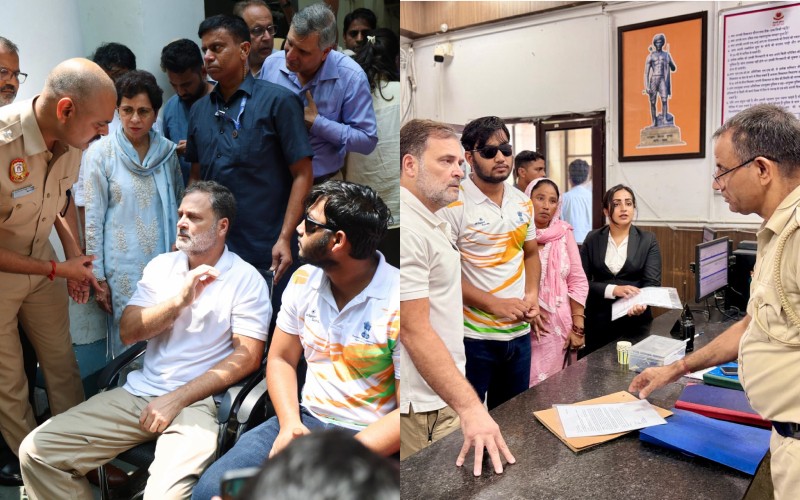
Congress leader and Leader of Opposition in the Lok Sabha Rahul Gandhi on Friday staged a sit-in outside the Parliament Street police station with 19-year-old Sahil Lochab, demanding registration of an FIR over the injuries he allegedly suffered during the July 20 protest.
Police sources said that an FIR was being registered based on Lochab’s complaint after the authorities collected his medical report and other relevant documents.
The development came after Gandhi refused to leave the police station and warned that he would continue his protest until the case was registered.
साहिल की FIR दर्ज न होने देने का एक ही मतलब है -
— Rahul Gandhi (@RahulGandhi) August 21, 2026
नरेंद्र मोदी और अमित शाह के राज में शांतिपूर्ण प्रदर्शन कर रहे युवाओं पर खुलेआम पैलेट गन चलाई जा सकती है, मगर उन्हें इंसाफ नहीं मिल सकता।
जब तक FIR दर्ज नहीं होती, जब तक दोषियों पर कड़ी कार्रवाई का भरोसा नहीं मिलता - हम डटे… pic.twitter.com/iJ6ojC9mmA
The episode has revived questions surrounding the security response to the July 20 student demonstration at Jantar Mantar and the conflicting claims over whether pellet guns were used during the police action.
Rahul Gandhi stages sit-in over FIR demand
Gandhi arrived at the police station accompanied by Lochab after the student and his legal representatives had sought police action over his injuries.
The Congress leader first approached the Mandir Marg police station before going to the Parliament Street police station and meeting senior police officials.
As the demand for an FIR remained unresolved, Gandhi began a dharna outside the police station.
"I will sit on dharna outside police station even for 30 days or six months if you don't register an FIR," Gandhi had warned the police.
According to reports, Lochab had submitted a written complaint to Delhi Police on August 14 through his lawyers.
The Congress alleged that he was not given an investigating officer's number or an acknowledgement.
The party said further attempts were made through email and telephone on August 17.
Delhi Police, however, said Lochab's complaint had been accepted and that the Crime Branch was already examining complaints connected with the July 20 protest.
Police indicated that his complaint would also be forwarded to the Crime Branch for investigation.
JanNayak 🔥 pic.twitter.com/l9sfgSHg9N
— Congress (@INCIndia) August 21, 2026
Gandhi displays pellets, medical reports
During the sit-in, Gandhi brought the alleged pellet injuries back before the cameras, displaying pellets that he said had been recovered from Lochab's body.
"Ye hai pellets, dekh lijiye inko, achhi tarah se dekh lijiye, ye hain pellets (These are pellets; take a look at them - look at them closely - these are pellets)," Gandhi said while showing the contents of a small plastic box.
He then questioned where the pellets had come from before answering himself.
"Ye inke shareer se aaye (These came from his body)," Gandhi said.
Lochab, who was wearing dark glasses, then showed the injuries on his body.
Gandhi claimed that more than 200 pellets were lodged in the student's body, including three in his eye.
"Ye inke yahan lage hain charre. 200 charre inke shareer ke andar hain aur teen charre inki aankh main hai (These pellets are lodged in his body. There are 200 pellets inside him and three are lodged in his eye)," Gandhi said.
He also displayed medical documents from Lady Hardinge Medical College and the All India Institute of Medical Sciences (AIIMS), saying they recorded the presence of more than 200 pellets in Lochab's body.
Lochab has undergone treatment at AIIMS after initially being taken to Lady Hardinge Medical College. Reports on his injuries have said he faces the possibility of losing vision in his injured eye.
Delhi Police deny use of pellet guns
Delhi Police has repeatedly denied using pellet guns against student protesters during the July 20 action.
The allegation has nevertheless remained contentious, with medical evidence and accounts from injured protesters prompting continued scrutiny.
An India Today report in July said doctors treating injured protesters had reported cases consistent with pellet injuries, while authorities had not officially confirmed the use of pellet ammunition.
The Central Reserve Police Force, whose Rapid Action Force was deployed at Jantar Mantar, has also not publicly accepted responsibility for using pellet guns during the operation.
A CRPF spokesperson previously declined to comment on the allegation.
A later report by The New Indian Express cited a report alleging that an RAF personnel fired seven pellet rounds during the July 20 student protest.
The CRPF had initiated an internal verification following allegations of excessive force.
The conflicting accounts have kept the question of who used the alleged pellet ammunition unresolved in the public domain.
How the pellet gun controversy unfolded
Pellet guns are designed to fire cartridges containing multiple small pellets that spread over a wider area.
They have been used extensively for crowd control in India, particularly in Jammu and Kashmir, where their use against protesters has previously caused severe injuries.
The Rapid Action Force (RAF), the riot-control wing of the CRPF, has historically used a range of crowd-control equipment.
The force was among the security units deployed during the July 20 protest in Delhi.
The allegations surrounding pellet gun use have become particularly sensitive because of the nature of Lochab's injuries.
He was among the students who participated in the protest at Jantar Mantar and later required hospital treatment.
In July, Gandhi appeared before the media with Lochab and accused security personnel of firing pellets at protesters.
He subsequently wrote to Union Home Minister Amit Shah demanding accountability over what he described as the use of "lethal force" against students.
July 20 protest remains under scrutiny
The July 20 demonstration was organised by the Cockroach Janta Party and centred on allegations concerning the NEET examination and demands for accountability over the paper leak controversy.
The protest escalated as demonstrators attempted to march towards Parliament.
Several protesters were injured during the police action, with allegations ranging from baton charges and tear gas to the alleged use of pellet guns.
Delhi Police has maintained that it did not deploy pellet guns, while reports citing injured protesters and medical findings have kept the issue alive.