
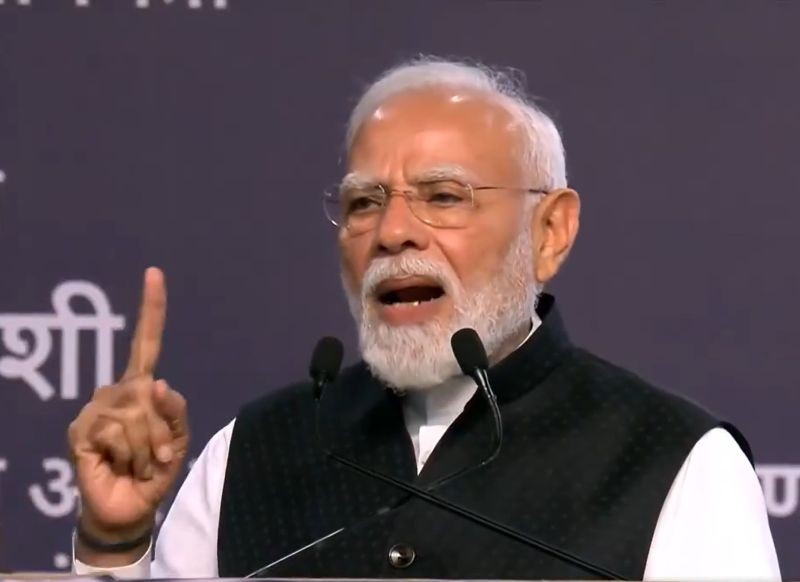
Addressing the centenary celebrations of Shri Ram College of Commerce (SRCC) in Delhi, Modi said he had introduced the term during his recent Independence Day address from the Red Fort.
“You may have heard my speech from Red Fort. I gave a homeopathic pill from the Red Fort - dimagi Naxal,” Modi said.
Drawing a parallel with homeopathic treatment, the prime minister said the condition could initially appear to worsen when treatment begins.
“Similarly, as soon as I gave the 'dimagi Naxal' homeopathic pill, all the 'dimagi Naxals' started coming out one after another. And now the public is also seeing the true colours of those who are promoting this illness,” he said.
#WATCH | Delhi: At the centenary celebrations of Shri Ram College of Commerce (SRCC), Prime Minister Narendra Modi says, "You may have heard my speech from Red Fort. I gave a homeopathic pill from the Red Fort—"Dimagi Naxal". According to the principles of homeopathy, when you… pic.twitter.com/c8NnLhmvMS
— ANI (@ANI) September 5, 2026
Modi’s message to Gen-Z
The prime minister’s address was largely focused on young Indians and the vision of building a developed India.
Urging students to think about the challenges India had faced in the past, Modi said people might underestimate the difficulties his government had confronted over the years.
“I have told you so many things. Some people may think, ‘What is this? This is a country of 140 crore people. It was very easy. What new thing did Modi do?’ But was it really that easy?” he said.
He then took the students back to some of the crises India had faced before his government came to power.
Modi criticises past handling of crises
Recalling the 2013 Kedarnath disaster, Modi criticised the then government's response, saying the administration had been shaken by the crisis and struggled to respond effectively.
He also targeted the previous government's handling of the 2008 global financial crisis, alleging that it failed to take decisive action and allowed India's banking system to be pushed towards the brink.
“When the banking crisis came in 2008, the government at the time tried to hide behind the crisis for years. It did not even have the courage to tackle it. The entire banking system of India was pushed to the brink of collapse,” Modi said.
‘Every time, people said India will not survive’
Modi also listed the major global challenges faced by his government, including the COVID-19 pandemic, the Russia-Ukraine war, disruptions to global trade and supply chains, and the crisis in West Asia.
He said India had repeatedly been told that it would struggle to withstand the impact of these crises.
“Every time, people said, ‘Now India will not survive,’” Modi said.
He added that his political opponents had hoped the crises would weaken his government, but claimed that the support of the people had helped India overcome those challenges.
Modi returns to SRCC after 13 years
The prime minister also recalled his earlier visit to SRCC in 2013, when he was serving as Gujarat chief minister.
His interaction with students at the college at the time attracted considerable attention on social media and became particularly prominent in the run-up to the 2014 Lok Sabha election.
Thirteen years later, Modi returned to the institution for its centenary celebrations, using the occasion to combine political criticism with a message urging young Indians to play a role in shaping the country’s future.